Public Works, Private Capital · Part 2 of 3
The price is the easy part. Bonds, grants, consent decrees, permits and contamination claims follow a water or sewer system out the door, or refuse to leave with it, under rules that no appraisal measures.
Ninety days. When a city sells a water or sewer system financed with tax-exempt bonds, federal tax regulations give it 90 days from the closing to redeem those bonds or fund an escrow that will. Miss the window and the bonds can lose their tax exemption retroactively, which is a problem for the bondholders, the city and the underwriter who sold the bonds on the strength of that exemption.
Nothing in the purchase price accounts for this. The appraisal that supported the price did not measure it either. It is one of perhaps a dozen obligations that attach to a municipal system and travel, or fail to travel, on their own rules when the system changes hands. Part 1 of this series asked which of three values governs a sale. Part 2 asks what else is in the deal.
Key takeaways for investors, lenders and their advisors
- The price settles one question. Debt, grants, decrees, permits, contamination and workforce each have their own transfer rule, and most of them are not in the seller's control.
- The buyer inherits the capital program, not the decree. A consent decree binds the parties who signed it. The government has to agree before a buyer is substituted, and the schedule that drove the sale becomes the buyer's rate case.
- Several closing conditions have federal clocks. The 90-day bond remedy, grant disposition approvals and permit transfer notices run on dates the parties do not set.

The composite city, ninety days later
Part 1 introduced a composite city assembled from public records in several states. It describes no single assignment. The city has now signed a purchase agreement for its century-old sewer system at a price well above book. The council has voted. The engineer's report has been filed with the commission.
Three calls come in the week after closing. Bond counsel wants to know when the outstanding revenue bonds will be redeemed, because the sale turned a public asset into private business use. The regional office of the Environmental Protection Agency (EPA) asks for the city's disposition request for the treatment plant it helped pay for in the 1980s. And the Department of Justice (DOJ), which signed the overflow consent decree with the city a decade earlier, reminds the city that it has not agreed to anything.
The city's lawyers knew about all three. Every item in this edition appears somewhere in a diligence checklist. What tends to get lost is the arithmetic: these obligations are priced by the buyer, paid for by the seller or the ratepayers, and absent from the appraisal that set the number everyone negotiated around.
The debt
Tax-exempt bonds
Most municipal systems carry revenue bonds issued on a tax-exempt basis. The exemption depends on the financed property staying in governmental use. Under Internal Revenue Code § 141, a sale to a private utility is private business use, and the bonds would become taxable private activity bonds unless the issuer takes a remedial action.
Treasury Regulation § 1.141-12 sets out the remedies. The one that matters in a sale is redemption or defeasance: the issuer must redeem the nonqualified bonds within 90 days of the deliberate action, or, if the bonds are not yet callable, fund a defeasance escrow within 90 days that will redeem them on the first call date. That second route is unavailable if the first call date is more than ten and a half years from the issue date. An alternative remedy, redeploying the sale proceeds to another qualifying use, requires that the consideration be exclusively cash and that the buyer pay fair market value.
The practical effect is that the sale proceeds are spoken for before the seller sees them. A city with $40 million of outstanding bonds and a $90 million price does not have $90 million to spend; it has a redemption to fund, an escrow agent to engage and a verification report to commission.
Rural utility loans
Systems financed by the U.S. Department of Agriculture's Rural Development program carry a different rule. Under 7 Code of Federal Regulations (CFR) § 1782.16, those loans cannot be defeased; they are paid off or assumed. And 7 U.S.C. § 1926(b) protects the borrower's service territory from encroachment for as long as the loan is outstanding, which means a buyer that also serves an adjacent area may find the protection working against it until payoff.
State revolving fund loans
Clean Water State Revolving Fund (SRF) loans for treatment works are made to public bodies under 33 U.S.C. § 1383(c). Drinking Water SRF loans may go to privately owned systems, depending on state law. A full sale of a wastewater system therefore ends the system's eligibility for the cheapest capital it had, and the outstanding SRF balance has to be retired or restructured under the state's own loan terms. Those terms vary by state and are rarely published in a form that is easy to read before the engagement starts.
Leases and operating contracts
Not every transaction is a sale. A long-term lease or concession raises the same private use question but has its own safe harbors. Revenue Procedure 2017-13 allows a management contract of up to the lesser of 30 years or 80% of the economic life of the property without creating private use, provided compensation and control tests are met. Revenue Procedure 2018-26 does similar work for certain leases. Part 3 returns to these structures.
The grants
A treatment plant expanded in the 1970s and 1980s was very likely built with EPA construction grants. During the 1970s and 1980s, that program sent more than $60 billion to local governments, and the grants carried a condition that the federally funded property not be sold, leased or encumbered without the agency's consent.
Two sets of rules now govern what happens at a sale.
The Uniform Guidance. Under 2 CFR § 200.311, a recipient that no longer needs federally funded real property for the grant's purpose must request disposition instructions, and the federal agency is entitled to its share of the proceeds or the fair market value. Under § 200.313, equipment with a current fair market value above $10,000 per unit is treated the same way; the recipient may keep $1,000 of the federal share from a sale to cover selling costs. Below the threshold, the equipment may be kept or sold without further obligation. The thresholds were raised in the 2024 revision of the guidance, and older grant agreements may still carry the lower figures.
Executive Order 12803. In 1992, the federal government addressed the privatization of grant-funded infrastructure directly. The order directs agencies to let state and local governments recoup their own investment first, then recover the federal grant less accumulated depreciation, with any remainder going to infrastructure or to debt or tax reduction. EPA's 2000 guidance on the privatization of federally funded wastewater treatment works applies that order to construction grants, and several states, Florida among them, wrote the order into their own privatization statutes so that local governments would use it.
For the appraiser, the grants matter twice. They explain why so much of the plant is contributed property that earns no return, which was the point of Part 1. And the federal share of the proceeds is a deduction from what the seller actually receives, which the price alone does not show.
Orders and decrees
About 700 communities in the United States have combined sewer systems, in which stormwater and sewage share a pipe and overflow together in heavy rain. Many of them operate under consent decrees with EPA, DOJ and their state agencies that set out capital programs over 20 or 25 years. The programs are among the largest capital commitments any city makes.
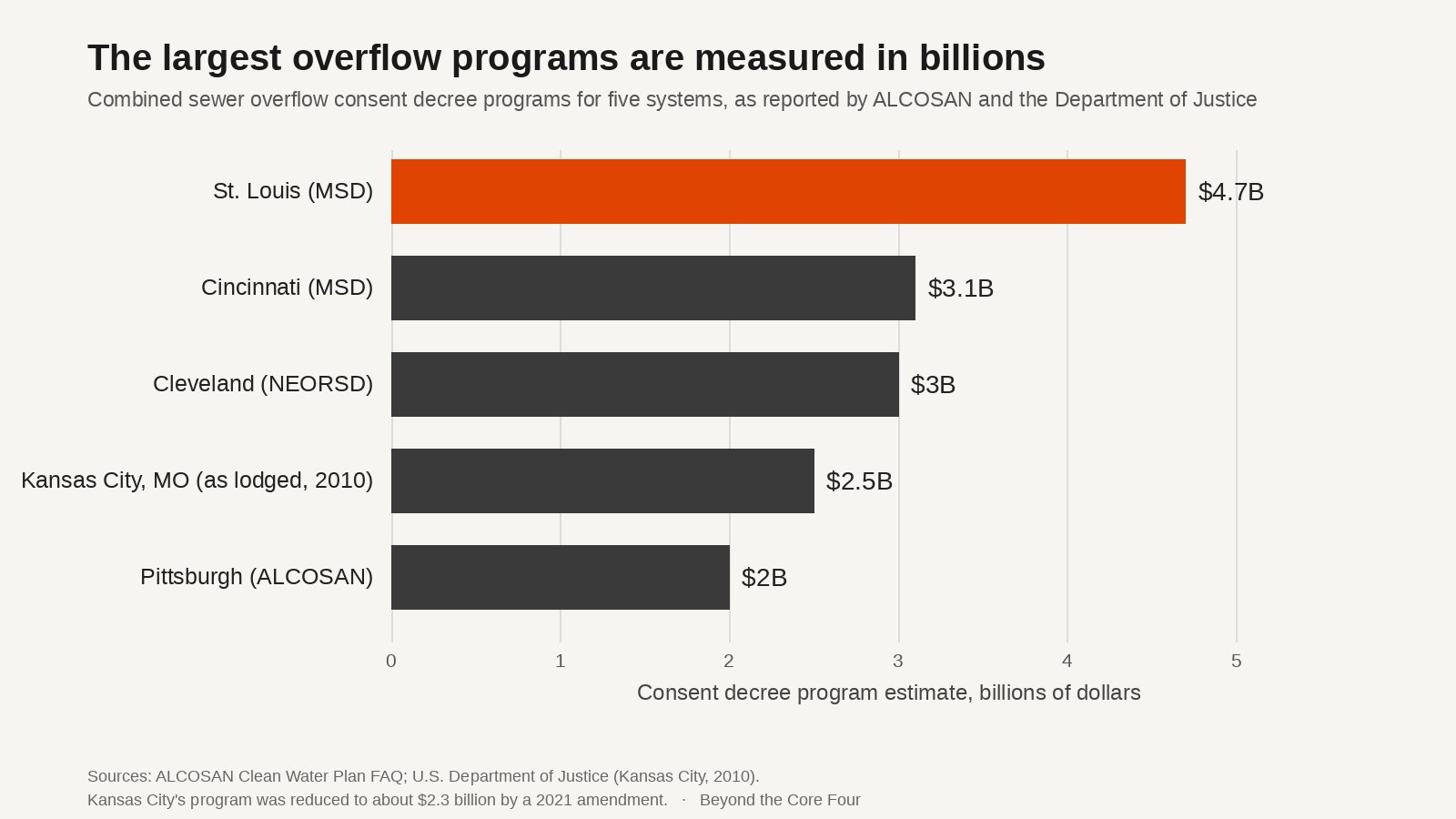
| System | Program estimate | Term |
|---|---|---|
| St. Louis (Metropolitan St. Louis Sewer District) | about $4.7 billion | 23 years |
| Cincinnati (Metropolitan Sewer District of Greater Cincinnati) | more than $3.1 billion | ongoing |
| Cleveland (Northeast Ohio Regional Sewer District) | about $3 billion | 25 years |
| Kansas City, Missouri | about $2.5 billion as lodged in 2010; cut to about $2.3 billion by the 2021 amendment, with compliance extended to 2040 | 30 years |
| Pittsburgh (ALCOSAN) | about $2 billion | ongoing |
A consent decree is a contract entered as a court order. It binds the parties who signed it. When a system is sold, the decree does not travel with the pipes; it stays with the city unless the United States agrees to substitute the buyer and the court approves. There is a precedent for that substitution. When the Scranton Sewer Authority sold its system in 2016, the amended decree named the buyer as the new defendant and released the authority. But that outcome was negotiated, and a buyer has to assume it will be too.
Three consequences follow.
- The decree schedule is the buyer's capital plan. Whatever the appraisal said about condition, the decree says what must be built and by when. A buyer that assumes the decree inherits a dated list of projects and the rate increases needed to fund them.
- Rate recovery is not automatic. Decree spending by an investor-owned utility goes to rate base only when the commission admits it. The affordability analysis that set the decree schedule in the first place is also in motion: EPA opened its financial capability guidance for comment in March 2026, and a revised framework could lengthen or shorten the schedules cities are negotiating now.
- An unassumed decree is the seller's problem. If the United States declines to substitute the buyer, the city remains liable for a program it no longer controls, and the purchase agreement has to say who pays.
Permits
A publicly owned treatment works (POTW) holds a discharge permit under the National Pollutant Discharge Elimination System. Transfer of that permit under 40 CFR § 122.61 requires at least 30 days' written notice to the permitting authority and a written agreement between the old and new owners fixing the date of transfer and the allocation of responsibility. Most states administer the program and have their own notice forms.
The harder question is status. POTW is defined by ownership. A privately owned plant treating municipal sewage is a "privately owned treatment works" under 40 CFR § 122.2, which changes the pretreatment program (the private owner no longer runs it; the permit writer has to decide how industrial users will be controlled), may change effluent limits, and ends Clean Water SRF eligibility for treatment works. EPA set out these consequences in guidance issued in the 1980s and has not substantially revised them.
A collection-system-only sale, with the city keeping the plant, raises a different set of questions about satellite systems. It is excluded from this series.
Contamination
Three liabilities sit in the ground and the sludge, and none of them appears on a balance sheet.
Superfund. EPA designated two per- and polyfluoroalkyl substances (PFAS) as hazardous substances under the Comprehensive Environmental Response, Compensation, and Liability Act in 2024. The U.S. Court of Appeals for the D.C. Circuit upheld that designation on August 18, 2026. EPA's enforcement discretion policy says the agency does not intend to pursue water and wastewater utilities as passive receivers, but that policy is nonbinding and does not bar private cost-recovery claims. Congress has not enacted a statutory exemption.
Drinking water limits. The April 2024 maximum contaminant levels for six PFAS remain in force, with a 2029 compliance date. In January 2026 the D.C. Circuit denied EPA's request to vacate four of the six limits while the litigation proceeds, and in March it declined to sever those claims. EPA's proposals to rescind four limits and to offer a conditional exemption to 2031 were not final when this was written. A buyer of a water system is buying the treatment capital either way; the question is whether it is building to four limits or six.
Sludge. There is no federal numeric limit for PFAS in biosolids. EPA issued voluntary draft guidance in late June 2026. Maine banned land application of biosolids in 2022, and a 2024 report prepared for the Maine Department of Environmental Protection found that management costs for many plants doubled almost overnight. Connecticut has since enacted its own ban. A plant that lands-applies its sludge today may be hauling it to a landfill, or an incinerator, tomorrow, and the cost shows up in operating expense, not in the plant appraisal.
Lead. For drinking water systems, the lead and copper rule requires a service line inventory and replacement program. EPA cut its national estimate of lead service lines from 9.2 million to 4.0 million in November 2025, which helped the national picture and did nothing for any particular city. The lines run under private property to the meter, and who pays for the private side is a local fight.

Physical and cyber exposure
The pipes break. A 2024 study from Utah State University put the national water main break rate at 11.1 per 100 miles per year and estimated that 19.4% of mains are beyond their useful life. The inspection grades engineers report for sewers under the National Association of Sewer Service Companies' assessment program describe condition and, as Part 1 noted, carry no defined remaining life.
The controls are the newer exposure. Water utilities have been the target of state-linked and criminal intrusions for several years, and reported attacks hit systems in at least seven states in July 2026. There is still no binding federal cybersecurity rule for the sector; drinking water systems serving more than 3,300 people must certify risk and resilience assessments and emergency response plans every five years under the America's Water Infrastructure Act, and wastewater has no equivalent federal mandate. New York adopted binding cybersecurity regulations for wastewater systems in March 2026, and other states are drafting. For a buyer, the supervisory control and data acquisition (SCADA) system is an asset on the equipment schedule and a liability in the security report, and both have to be priced.
Voters, proceeds and people
Voters. Several states give residents a vote on utility sales. New Jersey allows a referendum on petition of 15% of voters, and in November 2024 one township's voters rejected a $143 million sewer sale by about four to one. California and Wisconsin require a majority vote for certain sales. North Carolina added a public hearing and a public-interest finding in July 2026. The approval calendar can run a year or more, and the purchase agreement has to survive it.
Proceeds. Some states tell the seller what to do with the money. New Jersey's 2015 law and North Carolina's 2026 law both put debt retirement first. Where no statute speaks, the bond and grant rules above do, and pension funding has been the motive in more than one transaction. Allentown's 2013 lease of its systems to a county authority, for about $211 million, was structured to shore up the city's pension funds.
People. The National League of Cities, citing federal labor statistics, put roughly one-third of the water workforce within a decade of retirement eligibility in an April 2026 report. A buyer inherits operators who know where the valves are and which pump station floods. Whether those employees transfer, under what collective bargaining agreement, and with what pension obligations is a purchase agreement term and a going-concern value question at the same time.
Tax after closing
For the buyer and its advisors, four things change the day after.
- The plant becomes taxable property. Municipal utility plant is exempt from property tax. Investor-owned plant is assessed, in many states centrally, and the tax becomes an operating expense in the next rate case.
- Exempt facility bonds are hard to use for existing plant. Internal Revenue Code § 147(d) limits tax-exempt financing of existing property unless rehabilitation spending meets the statutory tests within two years. A buyer cannot simply refinance the purchase on a tax-exempt basis.
- The seller's proceeds are arbitrage-restricted until they are spent on the remedial action described above or otherwise applied under the regulations.
- Depreciation and basis follow Part 1: 25-year straight-line recovery for water utility property and municipal sewers, no bonus depreciation for rate-regulated water and sewer property, and a zero basis for contributed plant.
Why it matters, by reader
For lenders and investors
- Closing conditions are where the risk is priced. The bond redemption, grant disposition approvals, decree substitution and permit transfer are each a condition precedent or an indemnity. Ask for the schedule of each one and the party responsible.
- Escrows should match the open items. A holdback sized to the federal share of grant proceeds, the decree projects not yet bid and the PFAS treatment estimate is a different number from a standard working capital adjustment.
- Decree spending is a rate case before it is a return. Underwrite the commission's record on admitting environmental compliance capital, not the decree total.
- The operating budget moves after closing. Property tax, sludge disposal, cybersecurity compliance and the loss of SRF access all arrive in the first year. Model them.
For real property, trust and estate attorneys
- Build the approval calendar first. Referendum or petition windows, commission review, the 90-day bond clock, EPA disposition instructions and the court's approval of any amended decree run on different calendars. The purchase agreement has to accommodate the slowest.
- Read the grant agreements, not the summaries. Each one has a disposition clause, and the older ones differ from the Uniform Guidance.
- Easements and rights-of-way are still the title question. A collection system crosses private land under rights that were often never recorded. The buyer's title insurer will ask.
- Allocate the decree expressly. Silence on who pays for an unassumed decree is a dispute waiting for a rate case.
For accountants and certified public accountants
- Defeasance accounting. Under Governmental Accounting Standards Board (GASB) Statements 7 and 86, removing the debt from the statements requires a legal defeasance or an irrevocable trust holding essentially risk-free securities. The escrow verification report is the evidence.
- Arbitrage rebate on sale proceeds held before redemption is a compliance item for the seller's finance office, with a five-year computation cycle.
- The federal share of grant proceeds is a liability of the seller at closing, not a reduction of the sale price, and the two are often confused in the closing statement.
- Purchase price allocation under Internal Revenue Code § 1060 has to carry the assumed liabilities as part of consideration. An assumed decree program is consideration.
For municipal owners and operators
Before the offer arrives, know three dates and one list: the first call date on every outstanding bond issue, the closeout date of every federal grant, the compliance deadlines in every order and decree, and the list of equipment above $10,000 that federal money paid for. Keep the operators. They are the institutional memory the buyer is paying for.

Where the machinery and equipment fit
In Part 1 the equipment was the part of the system an owner buys again and again. In Part 2 it is the part the obligations name.
Consent decrees schedule equipment by name: pump station upgrades, standby generators, flow meters, disinfection systems. Grant records list equipment by purchase. Cybersecurity assessments inventory controls, programmable logic controllers and remote terminal units. A machinery and equipment appraisal that produces one schedule, reconciled to all three, saves everyone a second count.
Three practical points:
- The decree list and the asset list should agree. Where a decree requires a generator and the asset register shows none, either the work is not done or the register is wrong. Both matter to a buyer.
- Security is a condition item. A SCADA network on an unsupported operating system, or a control system reachable from the business network, is a deduction in the same way a cracked impeller is. It has a cost to cure.
- Grant-funded equipment has a federal co-owner. Any unit above $10,000 that federal money bought carries a disposition obligation. Flag it on the schedule.
What Part 2 leaves out, on purpose
Part 3 widens the lens to the rest of what a city owns: the city hall, the public safety building, the surplus school and the treatment plant it decided to keep. It takes up how public buildings are financed now, the concessions and availability-payment partnerships that move assets without selling them, the valuation of a building no one else can use, and what happens to value when a city takes a system back by eminent domain.
Frequently asked questions
Does a consent decree transfer when a city sells its sewer system?
Not by itself. The decree binds the signatories. Substituting the buyer requires the agreement of the United States and the state, and the court's approval of an amended decree. It has been done, but it is negotiated, not automatic.
What happens to tax-exempt bonds when a municipal utility is sold?
The sale is private business use. The issuer must take a remedial action under Treasury Regulation § 1.141-12, most often redeeming or defeasing the bonds within 90 days, or the bonds may lose their exemption.
Can a city keep the proceeds from selling a grant-funded treatment plant?
Only after the federal share is addressed. Under the Uniform Guidance and Executive Order 12803, the local government recovers its own investment first, the federal agency recovers its grant less depreciation, and any remainder is restricted to infrastructure or to debt or tax reduction.
Does a private buyer of a wastewater plant keep POTW status?
No. POTW status depends on public ownership. A privately owned plant treating municipal sewage is regulated as a privately owned treatment works, which changes pretreatment responsibility and ends Clean Water SRF eligibility.
The broader lesson
The appraisal answers the question it was asked: what the assets are worth under a stated standard of value. The transaction answers a wider one. Between the two sits a set of obligations with their own clocks, their own approvers and their own costs, and they are what a lender, a buyer and a city actually negotiate. An appraiser who knows they exist writes a better scope of work. A client who knows they exist asks a better question.
A question for your practice: of the obligations above, which ones are in your client's purchase agreement as a condition, which as an indemnity, and which are not mentioned at all?
The one-page checklist that accompanies this series, Twelve Questions Before a City Sells Its Utility, covers each of the obligations in this edition. Download the checklist (PDF).
If your firm would like a private presentation on these topics, feel free to reach out. I regularly present to law firms and legal teams (including continuing legal education (CLE)-style briefings), certified public accountant (CPA) firms and societies (including continuing professional education (CPE)-style sessions), family offices, lenders, owner-users and industry stakeholders on complex property and specialized asset issues.
Daniel Boring, CRE®, MAI, ARA, ASA | Senior Vice President – Valuation Advisory Services | Kidder Mathews
Beyond the Core Four focuses on specialized properties that fall outside the traditional industrial, retail, multifamily and office categories. The newsletter examines how value, risk and utility are shaped by the operational realities of assets such as quarries, marinas, agricultural facilities, processing plants, water-dependent operations and other complex property types where the real estate is only part of the story.
Case details, figures, ownership information and property identifiers have been modified or generalized to protect confidentiality. The discussion is based on real-world appraisal and advisory experience and is presented for educational purposes only. It is not intended as valuation advice, legal advice, tax advice, accounting advice, engineering advice or investment advice for any specific property, transaction or dispute, and it takes no position on any pending regulatory proceeding. Statutes, regulations and case status are described as of October 19, 2026 and change frequently.