Public Works, Private Capital · Part 3 of 3
A city hall has one buyer. A sewer system has several. The value of a public asset depends less on the asset than on where the question is asked, and the last part of this series follows the same city from the sale of its utility to the rest of its balance sheet.
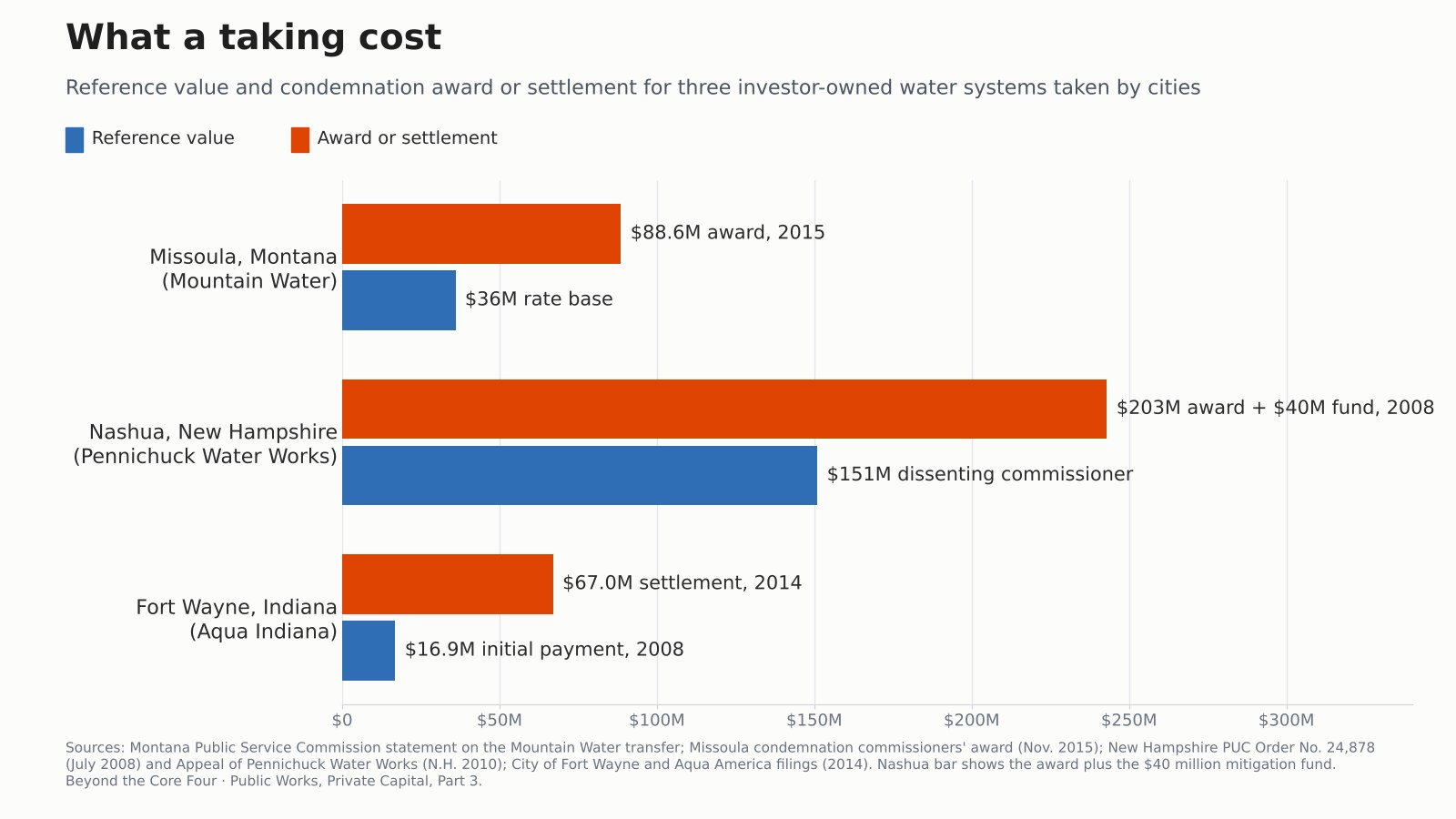
Three prices for one water system. In Missoula, Montana, the investor-owned utility that served the city earned its return on a rate base of roughly $36 million. When the city took the system by eminent domain, a panel of condemnation commissioners valued it at $88.6 million. By the time legal fees, financing costs and working capital were counted, the city put its total outlay at about $99 million.
None of those three numbers was wrong. Each answered a different question in a different forum. A rate case asks what the owner invested. A condemnation asks what a willing buyer would pay. A closing statement asks what it actually cost. Part 1 of this series asked which value governs when a city sells a utility. Part 2 followed the obligations that travel with the pipes. Part 3 widens the lens to everything else a city owns, and to what happens when the forum changes.
Key takeaways for investors, lenders and their advisors
- Most public buildings have no market. A courthouse, a city hall or a fire station is a special-purpose property with one user. Its value is a cost figure until a lease, a partnership or a sale gives it an income or a buyer.
- The structure decides who carries the risk. A concession transfers demand risk to the private partner and the ratepayer. An availability payment keeps it with the government and its annual appropriation. The accounting under Governmental Accounting Standards Board (GASB) Statement 94 follows that line.
- When a city takes a system back, the number moves. Condemnation awards for investor-owned water systems have run well above rate base, and the California Supreme Court has now made the city’s right to take a question of proof rather than deference.
The composite city, the morning after
Part 1 introduced a composite city assembled from public records in several states; it describes no single assignment. The sale of its sewer system has closed. The bonds are defeased, the federal share of the grant proceeds is in escrow, and the consent decree has been amended to name the buyer.
The council now turns to the rest of the inventory. There is a city hall built in 1962, a public safety building with a dispatch center that needs a new radio system, an elementary school the district closed two years ago and cannot sell, and the water treatment plant the city decided to keep. A finance director with a fresh capital plan and a shrinking tax base asks the same question about each of them: what is it worth, and worth to whom?
The honest answer is that the question is incomplete. Each asset has a cost, a possible income and a possible buyer, and the three rarely agree.

How public buildings are financed now
The default answer is still the bond market. According to London Stock Exchange Group (LSEG) data reported by The Bond Buyer, state and local governments issued $586.2 billion of long-term municipal debt in 2025, a record and 14.1% above the previous record set in 2024. New-money issuance, as opposed to refundings, rose 20.5% to $434.6 billion. Education was the largest sector at $150 billion, up 33.8%, and the K-12 subsector alone grew 37.2%. The federal tax exemption for municipal bond interest, which issuers feared losing in the 2025 budget reconciliation law, survived intact, and the fear itself pulled issuance forward.
The money is going into buildings. Public educational construction was running at a seasonally adjusted annual rate of about $114 billion in the spring of 2026, according to the Census Bureau. Public safety construction, which includes courthouses, police and fire facilities and correctional buildings, was running at roughly $21 billion a year in mid-2026, down about 8% from a year earlier as the pandemic-era federal money that funded many of those projects ran out.
Three pressures sit on top of the record issuance. Construction costs rose faster than general inflation for most of the decade, so a bond authorization approved in 2021 buys less building in 2026. Interest rates are higher than they were when many of those authorizations were sized. And the federal share of local capital budgets is falling: the infrastructure law’s supplemental money is largely committed, the fiscal 2027 appropriations were still running on a stopgap through December 11, 2026 when this was written, and the state revolving funds that carried water projects for forty years are returning to their base appropriations.
For a city that has just sold its sewer system, the lesson of Part 1 applies to the courthouse too. The buildings were paid for with debt that has a first call date, grants that may have conditions, and in some cases with certificates of participation or lease-purchase financing where the credit is not the city’s full faith but its annual appropriation. Before any building is leased, partnered or sold, the finance director needs the same three dates Part 2 asked for: the call dates, the grant closeouts and the lease terms.

Alternatives to a sale
A city that does not want to sell, or cannot, has three other ways to move a building’s cost off its current budget. Each moves value as well as cost, and each has a record.
Concessions and long leases
A concession or long-term lease transfers the right to operate an asset, usually for an upfront payment or a stream of payments, while the government keeps title. The water sector has the longest record.
Bayonne, New Jersey, leased its water and sewer system in 2012 to a joint venture of a private equity fund and a water operator for 40 years in exchange for a $150 million upfront payment, most of which retired debt. The contract guaranteed the operator a revenue path with annual increases of roughly 4%; the four-year rate freeze that officials described publicly lasted two years, and a 2016 analysis by The New York Times found that water rates had risen about 28% since the deal. Middletown, Pennsylvania, leased its system in 2015 and found that the lease allowed the operator to recover a shortfall in water sales from customers; the borough sued in 2018 to block the surcharge and did not stop it. Allentown’s 2013 lease of its systems to a county authority for about $211 million was structured to fund the city’s pensions, and Rialto, California, used a 2012 concession to recapitalize a system it could not afford to rebuild.
The pattern across these transactions is the same one Part 1 found in outright sales. The upfront payment is real and the relief is immediate. The cost arrives later, in rates, and the appraisal that supported the upfront payment did not measure it.
Availability-payment partnerships
A building does not produce revenue, so a concession in the water-sector sense does not fit. The structure that has emerged for courthouses, civic centers and schools is the availability-payment public-private partnership (P3), in which a private partner designs, builds, finances, operates and maintains the facility for 25 to 40 years and the government pays an annual fee for as long as the building is available and performing to specification.
Three examples define the current American market.
- Long Beach, California, closed $513 million of financing in 2016 for a new civic center: an 11-story city hall, a port headquarters, a main library and a park on six downtown blocks. The city and the port pay availability payments over 40 years; the city’s share was estimated at about $14.7 million a year against the $12.6 million it was already spending to operate and maintain seismically deficient buildings. The project required no bond issue, no tax measure and no voter approval. The buildings opened in 2019.
- Howard County, Maryland, reached financial close in October 2018 on a 238,000-square-foot circuit courthouse to replace a building 175 years old. The county pays the private partner about $10 million a year for 30 years, adjusted for inflation, after a milestone payment of about $75 million at occupancy that was financed with general obligation bonds. The courthouse opened in 2021.
- Prince George’s County, Maryland, approved in October 2020 the first availability-payment partnership for K-12 schools in the country: six schools designed, built, financed and maintained for 30 years, with total payments of about $1.24 billion over the term and a first-year payment of about $28.6 million. The six schools opened in under three years. A second phase of eight schools followed, with the maximum first-year payment raised to $70 million in 2024.
The appeal is speed and risk transfer: the partner carries construction cost overruns, schedule and lifecycle maintenance, and payments are reduced if the building is not available. The cost is that private taxable financing is more expensive than tax-exempt debt, which is why the Howard County structure took a large piece of the private financing out at occupancy with the county’s own bonds.
Lease-purchase and certificates of participation
The third route is the oldest. A city leases a building from a nonprofit corporation or a trustee, the lease payments are assigned to investors as certificates of participation, and the city owns the building at the end. The payments are subject to annual appropriation, which is what keeps them outside constitutional debt limits and voter-approval requirements. The credit is the city’s willingness to keep paying for a building it needs.
How the accounting treats them
The accounting follows the risk. GASB Statement 94, effective for fiscal years beginning after June 15, 2022, governs public-private partnerships and availability-payment arrangements. A service concession arrangement, in which the operator collects fees from the public, is recorded by the government as a receivable and a deferred inflow of resources, recognized as revenue over the term, with the underlying asset staying on the government’s books. An availability-payment arrangement, in which the government pays the operator, is treated as a financed purchase of the asset: the building goes on the books with a liability for the payments. Leases fall under GASB Statement 87, and software subscriptions under Statement 96.
The practical effect for a reader of the financial statements is that a $150 million upfront concession payment is not a $150 million gain in the year received. It is spread over 40 years, and a city that spent it on debt or pensions has traded four decades of revenue for one year of relief.
Valuing a building no one else can use
A courthouse is the textbook example of a special-purpose property: a building designed for a single use, with a single user, in a market where no comparable sale exists because no one else needs a courthouse. The appraisal literature calls these limited-market or special-purpose properties, and the cost approach dominates by default.
The cost approach has three parts, and each misleads in its own way.
Replacement cost new. For a 1962 city hall, the question is whether to estimate the cost of reproducing the building as built or replacing it with a modern equivalent. The answer changes the number by a wide margin, because no one would build a 1962 city hall today. Replacement cost of a modern equivalent is the defensible figure, and it is lower.
Depreciation. Physical deterioration is measurable. Functional obsolescence in public buildings is large and often unmeasured: floor plates designed for paper files, mechanical systems that cannot support current security and data loads, courtrooms sized for a docket that moved online, and accessibility deficits that cost more to cure than the building is worth. The Howard County courthouse was replaced because the old building could not handle caseloads, technology or victim safety, not because the walls were failing.
Land. The land under a public building is often its most marketable component, and in a downtown it may be worth more vacant than improved. That is a highest-and-best-use conclusion, and it leads to the surplus school.
The surplus school
School districts closed buildings in large numbers after enrollment peaked, and the disposition record is sobering. A 2013 study by The Pew Charitable Trusts of twelve urban districts found that they had sold, leased or reused 267 properties since 2005 and still had about 300 unused buildings on the market. Most sale prices fell between $200,000 and $1 million, well below the districts’ initial projections and in several cases a small fraction of assessed value. The typical building for sale was more than 60 years old, larger than 50,000 square feet and located in a residential neighborhood losing population. The most common reuse was a charter school, which competes with the district that sold it.
The valuation lesson is that a surplus school is worth what its site and shell are worth to the next user, not what it cost to build or what it carries on the district’s books. Deed restrictions and reverter clauses in the original conveyance can take even that value away: one Colorado district watched a closed elementary school revert to the city under a clause written into the deed decades earlier.
A government tenant as the income
Where a public building does have income, it is usually a government lease, and the income has a specific risk: appropriation. A lease that the tenant can end by declining to fund it is a different asset from a lease with a corporate guarantor, and the capitalization rate should say so. The same applies to availability payments. Investors in the Howard County or Prince George’s County partnerships are underwriting the county’s willingness and ability to appropriate for 30 years, and the credit analysis looks more like a general obligation rating than a real estate underwriting.

The equipment inside
The building appraisal stops at the shell and its fixed systems. The equipment inside is a separate schedule, and in public buildings it is often the larger number relative to the structure’s age.
A public safety building’s radio and dispatch system can cost more than the building’s structural value. A standby generator, an uninterruptible power supply and the switchgear behind them are machinery and equipment with service lives measured in years, not decades. Elevators, chillers, boilers and building automation systems sit at the border between real property and personal property, and the border matters for insurance, for a partnership agreement that allocates lifecycle replacement, and for a purchase price allocation. A machinery and equipment appraisal that produces one schedule, tied to the building’s drawings and the maintenance contract, is what lets each of those documents refer to the same list.
When the forum changes
The composite city sold its sewer system willingly. Many cities have gone the other direction, taking an investor-owned water system by eminent domain, and the record of those cases is the clearest evidence this series has that the forum sets the value.
| System | Reference value | Award or price | Forum |
|---|---|---|---|
| Missoula, Montana (Mountain Water) | Rate base about $36 million | $88.6 million, commissioners’ award, 2015; total city outlay about $99 million | Montana district court; Montana Supreme Court affirmed the right to take, 2016 |
| Nashua, New Hampshire (Pennichuck Water Works) | Dissenting commissioner: $151 million | $203 million plus a $40 million mitigation fund, 2008; upheld by the New Hampshire Supreme Court, 2010 | New Hampshire Public Utilities Commission |
| Fort Wayne, Indiana (Aqua Indiana) | Initial payment $16.9 million for the north system, 2008 | $67.0 million for the north and south systems combined, settlement approved 2014 | City board of public works; Indiana courts; settlement |
Three things stand out.
The award exceeds rate base. In Missoula the commissioners’ figure was roughly two and a half times the rate base on which the utility had earned its return. The Montana Public Service Commission said so plainly when the transfer closed: the city would pay bondholders more than the utility had been allowed to earn. Nashua’s regulators acknowledged the extraordinary difficulty of valuing a regulated utility and the state supreme court declined to disturb the figure. Ratepayers, in each case, pay the difference.
The right to take is now a question of proof in California. On August 24, 2026, the California Supreme Court decided Town of Apple Valley v. Apple Valley Ranchos Water, holding unanimously that when a public entity seeks to take a privately owned water, gas or electric utility, its resolution of necessity creates only a rebuttable presumption that the taking is necessary. The utility may rebut it at trial, and the trial court decides the question independently rather than deferring to the city for anything short of a gross abuse of discretion. In Apple Valley itself the trial court had found, after a 67-day trial, that the utility rebutted the presumption, and the town was ordered to pay the utility’s attorneys’ fees of more than $13 million. The Court of Appeal had reversed; the Supreme Court reinstated the standard the trial court applied and sent the case back.
The next test opened the day Part 2 of this series was drafted. On October 19, 2026, trial began in Monterey County Superior Court in the Monterey Peninsula Water Management District’s eminent domain action against California American Water, a case that began with a 2018 ballot measure, a rejected $449 million offer and a dispute over whether the district has the authority to run a retail water system at all. The Apple Valley standard will govern it.
Losing is expensive. A city that fails to prove its right to take pays the utility’s fees. A city that wins pays an award that reflects market value, not book, and finances it with debt that ratepayers service. Either way, the appraisal that the city commissioned before the resolution of necessity is the first exhibit, and it needs to have asked the right question.
The public buyer
Not every change of forum is adversarial. On June 30, 2026, a newly created quasi-public authority in Connecticut completed the $2.4 billion purchase of Aquarion Water Company from its investor-owned parent, $1.6 billion in cash and about $800 million of debt, after the state’s utility regulator first rejected the deal in November 2025 and then approved it in March 2026. Days after closing, the authority sold $2.35 billion of water revenue bonds to finance it. The towns in the service area objected to the loss of property tax revenue, which the authority addressed with payments in lieu of taxes, and to the loss of rate oversight, since the authority’s rates are set by its own board rather than the commission.
Aquarion is the mirror image of Part 1. There, a city sold to an investor-owned utility at a price above book and the premium went to Account 114. Here, a public buyer paid a market price for an investor-owned system, financed it with tax-exempt debt, and took the property off the tax rolls. The value was the same kind of number; the consequences ran the other way.
Property tax
Which raises the last forum. Public property is exempt from property tax. Investor-owned utility property is assessed, often centrally by the state. A private operator’s possessory interest in exempt public property is, in California and several other states, itself a taxable interest, so a concession or availability-payment partnership can create a tax bill where none existed. A city weighing a partnership for its civic center should ask who pays that bill, because the answer is in the agreement or it is in the rates.
The capital stack
For the lender and the investor, the sources of capital for public assets have shifted in five years, and the shift explains much of the deal flow.
- State revolving funds carried a large supplemental appropriation under the 2021 infrastructure law. That money is largely committed, and the funds are returning to base levels that have not kept pace with needs surveys measured in the hundreds of billions.
- The federal water loan program, the Water Infrastructure Finance and Innovation Act (WIFIA), had closed about 150 loans totaling roughly $24 billion in credit assistance, supporting about $53 billion of projects, as of early 2026. Closings slowed sharply in 2025.
- Private activity bonds for water and sewer projects remain subject to the state volume cap, which limits tax-exempt financing for private operators.
- Infrastructure funds have been active buyers of regulated utilities and partners in concessions, and the consolidation among investor-owned utilities continues: the merger of the two largest, announced in October 2025, cleared federal antitrust review in August 2026 and was awaiting final state approvals, with closing expected by the end of the first quarter of 2027.
- Public buyers, as Aquarion shows, can now compete for assets at market prices with tax-exempt debt, which changes the auction.
- The bond market itself, at $586 billion a year, remains the cheapest capital available to a creditworthy government, and the first question in any partnership analysis is why the city is not simply using it.

Why it matters, by reader
For lenders and investors
- Know which risk you are buying. A concession carries demand risk: if water sales fall, the shortfall is recovered from customers or not at all. An availability payment carries appropriation risk: the government pays if it funds the budget. The two are priced differently, and a term sheet that blurs them is mispriced.
- Underwrite the appropriation like a general obligation credit. A 30-year availability payment is a claim on a county’s budget, not on a building. The building has no alternative use.
- Condemnation is a valuation event. An investor-owned utility in a state with municipalization sentiment carries a put option the ratepayers will fund. Apple Valley made the option harder to exercise in California; it did not remove it.
- The public buyer is in the auction. A quasi-public authority with revenue bond authority can pay a market price and finance it more cheaply than any private bidder.
For real property, trust and estate attorneys
- Start with the enabling statute. Roughly three dozen states have some form of P3 enabling law, and fewer than half extend it to buildings. Where the statute is silent, the lease-versus-management-contract line and the appropriation clause do the work, and both have been litigated.
- The procurement record is the defense. Long Beach and Howard County both ran competitive procurements with multiple proposers. A sole-source partnership invites the challenge.
- Read the deed before declaring surplus. Reverters, use restrictions and grant conditions survive the closing of the school.
- In a taking, the resolution of necessity is now evidence, not a conclusion. In California, prepare the record as if a court will weigh it, because one will.
For accountants and certified public accountants
- GASB 94 decides the statement presentation. A concession is a deferred inflow recognized over the term; an availability payment is a financed purchase with a liability. Classify the arrangement before the deal is signed, because the choice shows up in debt ratios.
- Statements 87 and 96 govern the leases and the software subscriptions that ride alongside a partnership, and the three statements use the same term and discount-rate concepts.
- The upfront payment is not revenue. A city that spends a concession payment on pensions has consumed 40 years of deferred inflow in a year, and the financial statements will show that for 40 years.
- Property tax status changes with the structure. Possessory interest taxes and payments in lieu of taxes belong in the fiscal analysis.
For municipal owners and operators
Inventory before strategy. List every building, its original financing and call dates, its grant conditions, its deed restrictions and the equipment schedule inside it. Decide what the city needs to own, what it needs only to use, and what it does not need at all. The answer to the first question is a capital plan, the second is a partnership analysis, and the third is a disposition, and the appraisal for each asks a different question.
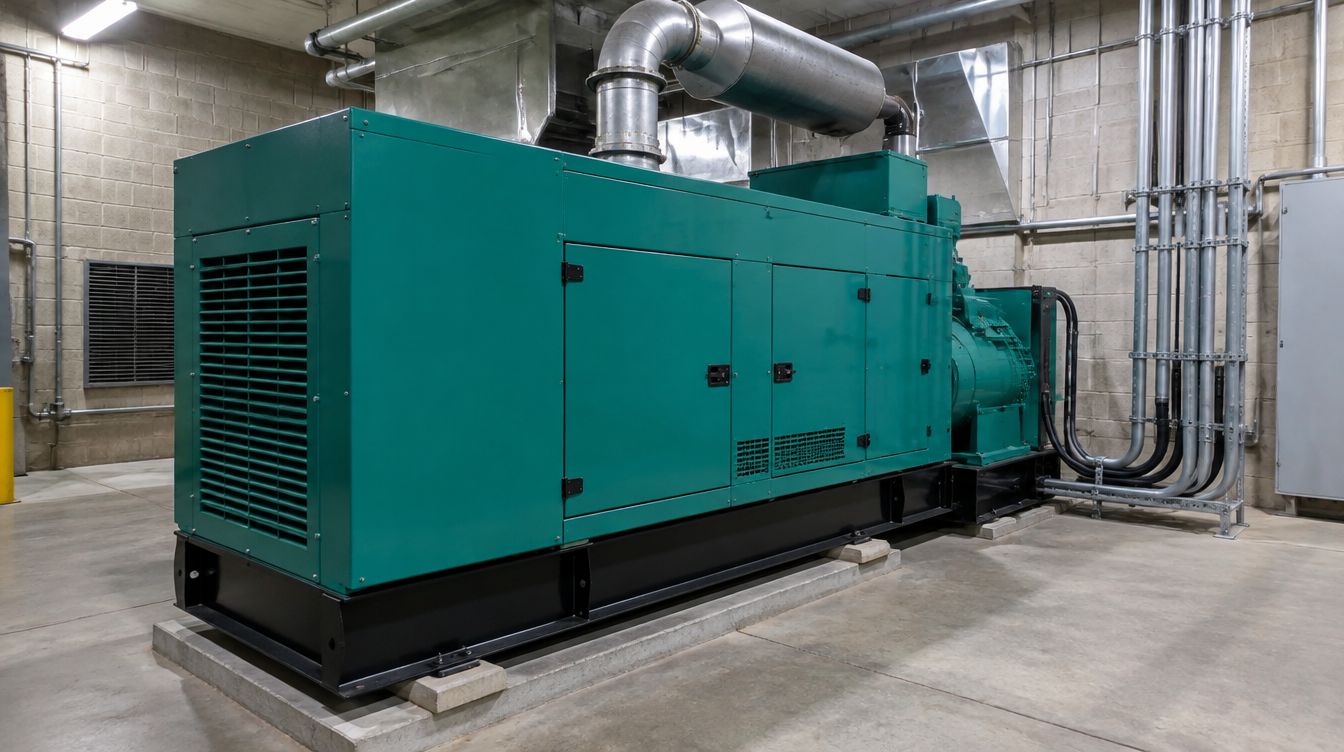
Where the machinery and equipment fit
In Part 1 the equipment was the part of the system an owner buys again and again. In Part 2 it was the part the obligations named. In Part 3 it is the part the partnership agreement allocates.
An availability-payment agreement assigns lifecycle replacement of building systems to the private partner for 30 years and hands the building back at the end in a specified condition. The Long Beach agreement, for example, requires the civic center to be returned in 85% like-new condition. That handback standard is a machinery and equipment question: which systems, at what remaining life, measured how. An equipment schedule prepared at financial close, with service lives and replacement costs, is the baseline against which the handback is measured three decades later.
Three practical points:
- Separate the fixed systems from the structure. Chillers, generators, switchgear, elevators, radio systems and building automation have their own lives and their own replacement cycles. A single depreciation rate for the building misstates all of them.
- The handback condition needs a baseline. Without an equipment schedule at close, the dispute at handback is about memory.
- Emergency systems are the critical path. In a public safety building, the dispatch and radio equipment is what the building is for. Value it, insure it and schedule its replacement separately.
What this series leaves out
Three subjects were held back on purpose. The sale of a collection system alone, with the treatment plant retained, raises questions about satellite systems and pretreatment that deserve their own treatment. Flood protection works, which are increasingly bundled with stormwater utilities, have a different regulatory and funding structure. And the effect of a cost-only valuation statute on the appraiser’s scope of work is a subject for a later edition, once a related engagement has closed.
Frequently asked questions
How is a courthouse or city hall valued? Usually by the cost approach, because there is no market for a building with one user. The useful figures are replacement cost of a modern equivalent, less physical deterioration and functional obsolescence, plus land at its highest and best use. Where the building has a government lease or an availability payment, the income approach applies, with the capitalization rate reflecting appropriation risk.
What is an availability-payment public-private partnership? A structure in which a private partner designs, builds, finances, operates and maintains a facility for 25 to 40 years and the government pays an annual fee for as long as the facility is available and performing. Long Beach’s civic center, Howard County’s courthouse and Prince George’s County’s schools are the leading American examples.
How much does a city pay to take an investor-owned water system by eminent domain? Market value as determined in the forum the state assigns, which has run well above rate base: $88.6 million against a rate base near $36 million in Missoula, and $203 million plus a $40 million mitigation fund in Nashua. In California, after the Apple Valley decision of August 2026, the city must also be prepared to prove the necessity of the taking at trial.
How does GASB 94 treat an upfront concession payment? As a deferred inflow of resources, recognized as revenue over the term of the arrangement, not as revenue in the year received.
The broader lesson
Across three parts, the method has not changed. Before anyone states a value for a public asset, inventory the rights, the obligations and the ledgers. The rights decide who can sell, lease or take. The obligations decide what travels with the asset and what stays behind. The ledgers decide which number each forum will recognize. A rate case, a condemnation panel, a concession agreement and a closing statement will each produce a different figure for the same pipe or the same building, and each will be correct for its purpose.
The appraiser’s job is to know which question is being asked and to say so in the scope of work. The client’s job is to ask the right one. Public Works, Private Capital ends here; the next edition turns to a new asset class.
A question for your practice: of the public buildings your client owns, which ones does it need to own, which does it need only to use, and which does it not need at all?
The one-page checklist that accompanies this series, Twelve Questions Before a City Sells Its Utility, covers the issues in all three parts. Download the checklist (PDF).
If your firm would like a private presentation on these topics, feel free to reach out. I regularly present to law firms and legal teams (including continuing legal education (CLE)-style briefings), certified public accountant (CPA) firms and societies (including continuing professional education (CPE)-style sessions), family offices, lenders, owner-users and industry stakeholders on complex property and specialized asset issues.
Daniel Boring, CRE®, MAI, ARA, ASA | Senior Vice President – Valuation Advisory Services | Kidder Mathews
Beyond the Core Four focuses on specialized properties that fall outside the traditional industrial, retail, multifamily and office categories. The newsletter examines how value, risk and utility are shaped by the operational realities of assets such as quarries, marinas, agricultural facilities, processing plants, water-dependent operations and other complex property types where the real estate is only part of the story.
Case details, figures, ownership information and property identifiers have been modified or generalized to protect confidentiality. The discussion is based on real-world appraisal and advisory experience and is presented for educational purposes only. It is not intended as valuation advice, legal advice, tax advice, accounting advice, engineering advice or investment advice for any specific property, transaction or dispute, and it takes no position on any pending regulatory or judicial proceeding. Statutes, regulations and case status are described as of October 25, 2026 and change frequently.