Subtitle: Decibel caps at the property line, dark-sky rules, and generator-testing windows are quietly redrawing the buildable envelope — while the nuisance docket grows faster than the ordinances
The impairment no photograph captures
Appraisers are trained to document what a camera can hold: the roofline, the setbacks, the condition of the paving, the view from the front door. But the newest impairment in American land use doesn’t photograph. It arrives at 2 a.m., through a closed window, as a low-frequency hum that one Michigan resident described this way: “It sounds like someone set up a vacuum, like in your living room.” It never shuts off. The camera sees a quiet residential street; the sound meter — and increasingly the federal docket — tells a different story.
This is the third edition in our data-center series. The first followed the power: the megawatts that live in paperwork the county recorder has never seen. The second followed the water: permits that are licenses, not property. This one follows the two impacts that have put more ordinary neighbors into federal court than any other feature of the AI buildout — noise and light — and traces what they are doing to entitlements, site plans, operating budgets, and, ultimately, value. For the attorneys, CPAs, and lenders this series is written for, the message is uncomfortable in a specific way: a facility can comply with the noise ordinance and still end up a defendant, and the ordinances themselves are being rewritten mid-project in ways that shrink what a parcel can actually hold.
Key takeaways for attorneys, CPAs, and lenders
- The nuisance docket is national now. In roughly a year, residents have filed noise-driven class actions against data-center operators in Mississippi (a putative class of more than 10,000 residents), Michigan, Wisconsin, New Jersey, New York, and Texas — where a case has already survived a motion to dismiss. Compliance with the local ordinance has not stopped the filings.
- The measurement standard is the fight. Most noise ordinances are written in A-weighted decibels, a scale that systematically understates the low-frequency hum data centers emit. The jurisdictions that have caught on — Prince William County most prominently — are moving to C-weighted and octave-band limits, and the difference between those standards can decide whether a built facility is legal.
- Noise and light are now dimensional constraints. New ordinances impose equipment setbacks of 300 to 400 feet from residential districts, property-line decibel caps, evergreen screening, and dark-sky lighting standards. On a mid-sized parcel bordered by homes, those requirements can sterilize a meaningful share of the acreage — before the first building permit is filed.
Beyond the Core Four examines specialized properties outside the traditional industrial, retail, multifamily, and office categories — quarries, marinas, agricultural facilities, processing plants, and other assets where the real estate is only part of the story. This is the third edition of our data-center series: the first took on power, the second water. This one takes on the neighbors — and what their complaints are doing to the buildable envelope. One more remains: the jobs, the tax deals, and the clawbacks.
What the neighbors actually hear
Start with the physics, because the physics explains the litigation. A data center at capacity can emit sound around 96 decibels at the equipment; backup diesel generators reach roughly 105 — jet-engine territory. What reaches the property line is quieter but relentless: continuous mechanical cooling, running 24 hours a day, every day, with no weekend and no season. Research collected by the Environmental and Energy Study Institute links sustained exposure above 65 decibels to elevated stress and blood pressure, and nocturnal noise to sleep loss and reduced cognitive performance. In Northern Virginia — nearly 300 operating data centers — almost a third of facilities sit within 200 feet of residentially zoned land, and Prince William County residents have recorded levels routinely exceeding 60 decibels.
The character of the sound matters as much as the level. Data-center noise concentrates in the low frequencies, which travel farther, penetrate walls, and — critically — barely register on the A-weighted scale most ordinances use. As one national parks advocate put it, because the noise spans multiple frequency ranges, particularly low ones, “it is difficult to measure” — which in practice means a sound that keeps a household awake can read as compliant on the county’s meter. That gap between the instrument and the experience is where the lawsuits live.
And when the facility generates its own power, the problem compounds. A reporter who visited a turbine-powered campus in Sterling, Virginia last year described “an all-encompassing, monotonous whoosh accompanied by a low rumble,” like “a jet engine that never stops running.” The operator’s position — third-party studies confirm ordinance compliance — and the neighbors’ position — the noise is constant and intolerable — are both, in a narrow sense, true. That is precisely the problem.
The docket: eighteen months that changed the risk profile
Edition one of this series flagged the nuisance wave in a paragraph. It deserves a section now, because the pattern across cases is remarkably consistent — and consistently relevant to diligence.
- Southaven, Mississippi. Haley v. X.AI Corp. (N.D. Miss., filed June 8, 2026): three named plaintiffs on behalf of a putative class exceeding 10,000 residents, alleging that more than 50 methane gas turbines powering the Colossus data centers create “near-constant noise, vibrations and other nuisance-level harms” — public and private nuisance, sleep disruption, tinnitus, diminished property values, punitive damages. The NAACP filed a separate Clean Air Act suit in April 2026 over the turbines, and the Justice Department has signaled intervention on the operator’s side, citing federal AI priorities. Read that sentence again: the federal government intervening in a neighborhood noise-and-emissions fight as a matter of national strategy.
- Dowagiac, Michigan. Valenzuela v. Alliance Cloud Services, LLC (W.D. Mich., filed May 26, 2026): a class defined as every owner-occupant and renter within one mile of a converted bitcoin-mining facility now running AI workloads. The complaint’s numbers tell the ordinance-gap story in miniature: the city’s residential limits are 65 decibels daytime and 55 overnight; the facility allegedly produces 48 to 62 at the receiving properties, continuously. Reporting on the dispute indicates the operator has been cited under the local noise ordinance and has discussed purchasing nearby homes — and the facility’s disclosed expansion plans run from 30 megawatts to 340. When the operator’s community-relations strategy includes buying the neighbors’ houses, an appraiser takes note: that is market evidence, of a kind.
- Mount Pleasant, Wisconsin. In early July 2026, three residents filed a class action against Microsoft over the Fairwater campus — 315 acres, operational since April 2026, reported at $7.3 billion — on behalf of roughly 1,000 residents within a mile and a half. The reported allegations reach beyond operating noise to construction noise and light pollution. Light. We will come back to that.
- Vineland, New Jersey. A federal class action filed in late May 2026 against DataOne (operated by Nebius Group) alleges the hum from a 2.6 million-square-foot, roughly 300-megawatt campus — behind 14-foot concrete walls the plaintiffs call inadequate — reaches about 1,013 households within a mile. A county health inspection had already issued a violation for exceeding 50 decibels between 10 p.m. and 7 a.m. The campus anchors a reported $17 billion compute arrangement with Microsoft; the nuisance exposure now travels with it.
And the survivor. The WilmerHale litigation survey cited in edition one catalogs noise and vibration class actions in New Jersey, Michigan, and New York, plus a Texas case that has already survived a motion to dismiss. That last item is the one for the credit memo: these claims are not being screened out at the pleading stage. The theory — old-fashioned nuisance, dressed in new facts — is getting to discovery.
The professional takeaways compound across cases. Nuisance liability does not require an ordinance violation; the Dowagiac facility is alleged to run below the daytime cap and is a defendant anyway. Class definitions are geographic — everyone within a mile, a mile and a half — which converts a site-selection radius into a damages multiplier you can read off a parcel map. And the remedy demands include injunctive relief: the worst case is not a check, it is an order constraining how the facility runs.
The ordinances: rewriting the ruler
While the plaintiffs’ bar works the common law, local governments are working the code books — and the most consequential fight is not over the number, it is over the scale.
- Prince William County, Virginia is the national test case. The county convened a data-center noise advisory group in 2022, retained acoustics consultants, and developed octave-band limits — frequency-by-frequency caps designed to catch exactly the low-frequency energy that A-weighted ordinances miss. Then, in 2026, a deputy county executive proposed raising the recommended octave-band levels by six decibels — an adjustment one advisory-group member calculated as “a quadrupling of noise energy and a 50% increase in the perceived noise,” and another called a misrepresentation of the group’s work. As of this fall the draft remains in staff review, headed for a board work session. Whatever emerges, the direction is set: the sophisticated jurisdictions are abandoning the single-number dBA cap for octave-band and C-weighted standards purpose-built for this asset class.
- Kent County, Delaware shows what a finished, modern ordinance looks like. Adopted July 23, 2026: data centers confined to industrial zones; a 55-decibel cap at the property line; buildings at least 300 feet from residential districts; generators, chillers, and cooling towers at 400 feet (reducible to 300 only inside noise-reducing enclosures); two staggered rows of six-foot evergreens along roads and residential boundaries; written confirmation of water and power capacity before approval; and 100% financial assurance for demolition and site restoration if the facility sits dark for a year. Noise, light, screening, utilities, and decommissioning — one instrument.
- Chandler, Arizona is the cautionary tale about time. Residents of the Brittany Heights subdivision began complaining about a data-center hum in late 2014. The operator committed to sound-mitigation equipment in 2018. The city adopted restrictive zoning amendments in 2022 — effectively confining new facilities to an existing corridor — and by 2025 was unanimously rejecting new proposals with noise in the record. A decade from first complaint to closed door. Communities remember, and the next applicant inherits the memory.
The model ordinances now circulating — from community defense groups, state environmental organizations, and county planning associations — converge on a recognizable package: 60 dBA daytime and 55 nighttime at residential boundaries, C-weighted companions around 73/68 to catch the low end, octave-band tables as the enforcement backbone, sound studies as a condition of approval rather than an after-the-fact defense, generator testing confined to weekday daytime windows, and setbacks measured in the hundreds of feet. Frederick County, Maryland has floated separation distances measured in miles from sensitive facilities. Not all of this will pass everywhere. Enough of it is passing to change what a “data-center site” means dimensionally.
Run the arithmetic on that. A square 100-acre parcel is roughly 2,090 feet on a side. If one boundary faces homes, a 400-foot equipment setback sterilizes about 19 acres for the noisiest — and most essential — components before design begins; two residential boundaries, and more than a third of the parcel is constrained.
That is my arithmetic on the ordinance text, offered as illustration, not a reported figure. Add the screening rows, the sound-wall footprints, and the internal separation the acoustic study demands, and the buildable envelope a buyer thought it was pricing may be a different shape than the one the ordinance leaves behind. In edition one I argued the most valuable attribute of a data-center site is paperwork. Here is the corollary: some of the most expensive square footage on these sites is the part that must stay empty.
Light: the impact nobody underwrote
Noise at least has a meter. Light is earlier in its regulatory life, and that makes it the sleeper.
A hyperscale campus is lit all night, every night — perimeter security lighting, parking, loading, rooftop equipment — and it is frequently sited on cheap rural land where the ambient night sky was, until groundbreaking, genuinely dark.
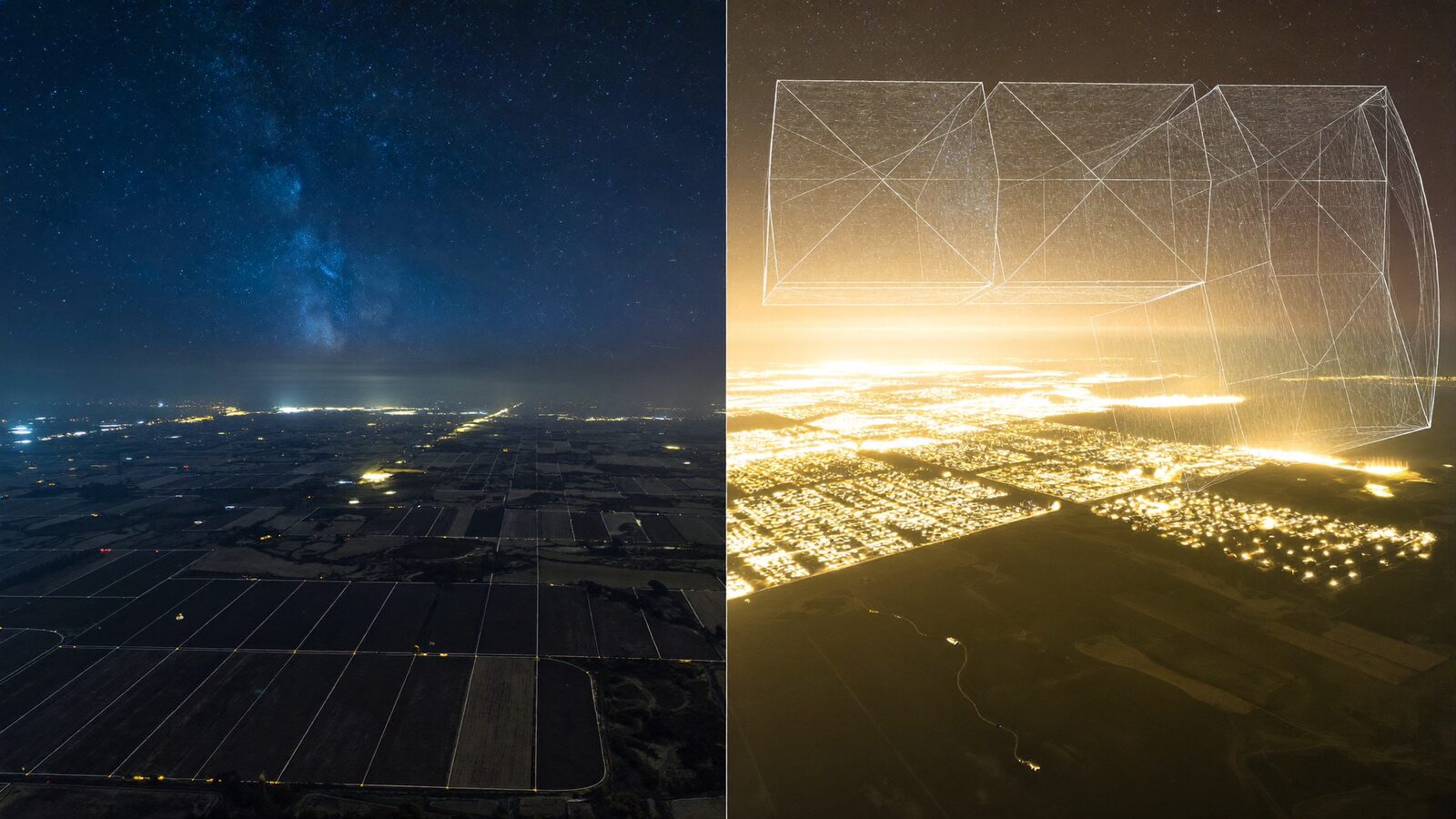
DarkSky International, the standards body behind the dark-sky movement, issued a statement on data-center development making the case that most of this is over-engineering: “brute force” security lighting where a fraction of the illumination would serve. Its recommended package is concrete and cheap relative to the capex it rides on: light only what needs lighting (their technical guidance runs to roughly 2 lux for parking and 10 for active work areas), full-cutoff fixtures so no beam escapes above the horizontal, motion sensors and dimming after hours, and color temperatures at or below 3000K to cut atmospheric scatter. The evidence that this works is not hypothetical — oil and gas operators have documented light-pollution reductions near 98% with 60% lighting-energy savings, and Tucson cut total skyglow 7% during a citywide LED retrofit even as the city grew.
The regulatory uptake is following the noise playbook, a few years behind: footcandle caps at the property line (model ordinances run 0.1 at commercial boundaries and 0.05 at residential), fixture shielding requirements, curfews on non-essential lighting, and photometric plans filed with the site plan. And the litigation uptake has already begun — the Mount Pleasant complaint’s reported inclusion of light pollution alongside noise marks the claim’s arrival in the class-action format. For counsel, the diligence point is symmetrical with sound: ask for the photometric study the way you ask for the acoustic one. For the lender, the retrofit asymmetry is the point: shielded fixtures and controls specified at design cost little; re-lamping a delivered campus under a consent order costs more, and an injunction constraining operations costs most.
The value question: what the evidence actually shows
Here is where my profession has to be honest about the state of the record, because both sides of every data-center hearing are currently overclaiming.
The plaintiffs’ complaints uniformly allege diminished property values. The best empirical work to date points the other way — with caveats that matter. A February 2026 study out of the University of Rochester’s Simon Business School matched Virginia air-permit issuances to ZIP-code-level home price indices in a difference-in-differences design and found effects that are “economically small and slightly positive,” with confidence intervals excluding large declines — no evidence, in the aggregate, that data centers drag down nearby home prices. Industry press has run similar findings. But note what a ZIP-code-level index cannot see: the specific street within 500 feet of the cooling plant, the specific houses the Dowagiac operator reportedly offered to buy. Aggregate neutrality and localized impairment are fully compatible — every appraiser who has worked a highway-widening or landfill assignment knows the shape of that curve. What does not yet exist, anywhere, is a published paired-sales study isolating data-center noise or light as a value driver. Until it does, expect assessment appeals, condemnation-style diminution claims, and lender collateral reviews to be argued on adjacent evidence — and expect the first well-documented resale data from streets like Brittany Heights to be worth more than any expert’s model.
For the CPAs: the exposure shows up before any verdict. Mitigation retrofits are capital expenditures nobody budgeted. Class actions with mile-radius class definitions are disclosable contingencies. And a consent decree limiting generator testing or night operations is an operating constraint with revenue consequences — the kind of item that belongs in the audit-committee conversation while it is still a zoning condition, not yet a court order.
What this does to the deal
Pull the threads together and the diligence file for a data-center site — or for any client who owns land near one — grows by a chapter.
The sound study is now an entitlement document. Edition one argued the entitlement record deserves survey-level scrutiny; the acoustic study has joined it. Was it modeled at the property line or at the nearest receptor? In dBA only, or in dBC and octave bands? At build-out or at phase one? Against the ordinance in force, or the draft ordinance in the pipeline? A study that validates phase one in dBA is not evidence that a 340-megawatt build-out passes an octave-band table that does not exist yet — and Dowagiac shows exactly how that gap becomes a federal complaint.
Conditions of approval are the real site plan. Generator-testing windows, equipment-location restrictions, sound-wall heights, lighting curfews, landscaping maintenance obligations — these run with the approval and bind the successor. A buyer pricing the dirt should price the conditions; a lender should ask which conditions, if violated, put the certificate of occupancy in play.
Nuisance survives compliance — so structure for it. Indemnities against third-party nuisance claims, escrows for mitigation retrofits, representations about complaint history (ask for the code-enforcement file; it is a public record and plaintiffs’ counsel will read it), and insurance review for whether the liability program actually responds to gradual-nuisance claims, which many pollution exclusions were drafted to catch.
And for the neighbors’ side of the fence — because many of the clients calling their attorneys and CPAs about data centers do not own the data center; they own the farm next door — the same documents read in reverse. The ordinance’s setbacks burden the operator’s parcel but may also shape what the neighboring owner can claim; the complaint history is the foundation of a nuisance file; and the operator’s own buyout offers, where they exist, are admissions about value that no adjacent owner should negotiate without understanding.
Coming in this series
One edition remains in the data-center arc of Beyond the Core Four:
- Jobs and the fiscal bargain: what a community actually receives for its incentives, what it gives up, and how clawback provisions are being drafted for the promises that miss. The Brookings employment data, the dueling Georgia and Virginia incentive audits, and the repeal bills already filed — the ledger, examined.
Ten questions before your client signs
- What does the acoustic study actually model — property line or nearest receptor, dBA alone or dBC and octave bands, phase one or full build-out — and who stands behind it?
- Which noise standard governs: the ordinance in force today, or the draft standard the county’s advisory group is writing while the project is under review?
- Where must the loudest equipment sit under current and proposed setbacks, and how many buildable acres does that leave — at this build-out and the next one?
- What do the conditions of approval say about generator testing windows, sound walls, lighting curfews, and screening — and do they bind successors and survive foreclosure?
- What is in the code-enforcement and complaint file for this site and this operator’s other sites — and has anyone read it before the plaintiffs’ bar does?
- How many residential parcels sit within one mile — the class-definition radius the current complaints are using — and what would a geographic class of that size mean for exposure?
- Does the liability program respond to gradual noise, vibration, and light nuisance claims, or do pollution and expected-injury exclusions swallow the coverage?
- What would a retrofit cost — acoustic enclosures, low-noise chillers, full-cutoff lighting — versus specifying it at design, and who bears it under the contracts?
- If an injunction constrained night operations or generator testing tomorrow, what happens to the service-level commitments, the utility minimums from edition one, and the pro forma?
- For the client who owns land nearby: what do the operator’s own studies, conditions, and any buyout offers establish about impacts — and what is the strategy for the assessment appeal either way?
The quietest line in the ordinance
Every edition of this series ends at the same place: the value is not where the camera points. Power lives in tariffs; water lives in revocable permits; and the newest constraint on data-center land lives in an octave-band table most purchase agreements have never heard of. A parcel’s highest and best use is now bounded not only by what the grid can deliver and the aquifer can spare, but by what the neighbors can hear at 2 a.m. and see from the back porch — and by how fast their county learns to write that into law.
The professionals who serve these deals — and the owners across the fence from them — should treat sound and light the way this series has treated every other invisible attribute: as rights and burdens to be inventoried, measured, priced, and papered. That is the work our team does on complex real estate and personal property: finding the value, and the liability, in the attributes that never make the listing photos. Next time, the series closes where every county hearing ends up — the jobs, the tax deals, and what happens when the promises miss.
A question for your practice: When a client calls about a data-center deal — on either side of the fence line — does anyone in the room know which weighting scale the county’s noise ordinance uses, and whether the facility passes on the other one?
If a client’s holdings raise these questions — a site under a contested noise ordinance, land bordering a data-center campus, a facility where mitigation obligations and property rights intertwine — that intersection of complex real estate and personal property is where our team works. We regularly speak to law firms and legal teams (including CLE-style briefings), CPA firms and societies (including CPE-style sessions), lenders, family offices, owner-users, and industry groups on complex property and specialized asset issues. If your firm would like a private session on these topics, feel free to reach out.
Daniel Boring, CRE®, MAI, ARA, ASA | Senior Vice President – Valuation Advisory Services | Kidder Mathews
Sources and further reading
Litigation: Haley v. X.AI Corp., N.D. Miss. (filed June 8, 2026) — Mississippi Free Press and DeSoto Times coverage; Valenzuela v. Alliance Cloud Services, LLC, W.D. Mich. (filed May 26, 2026) — ClassAction.org, Spectrum News, and Tom’s Hardware coverage; Mount Pleasant, WI class action v. Microsoft (July 2026) — FOX6 Milwaukee and Tom’s Hardware coverage; Vineland, NJ class action v. DataOne/Nebius (May 2026) — Governing/GovTech coverage; WilmerHale, “Data Centers in Court: The Emerging Wave of Nuisance, Environmental, and Land-Use Litigation” (July 13, 2026); Crowell & Moring, “Data Centers in the Crosshairs” client alert (2026); NAACP Clean Air Act suit coverage (CNBC, Feb. 2026; SELC).
Ordinances and regulation: Kent County, DE data-center zoning ordinance (adopted July 23, 2026) — Technical.ly coverage; Prince William County, VA Data Center Ordinance Advisory Group materials and JMT consultant presentations (2024–2026); InsideNoVa advisory-group coverage (2026); Chandler, AZ zoning history — ABC15 and Chandler Arizonan coverage, EESI; Community & Environmental Defense Services, model data-center noise and lighting standards; PennFuture model ordinance sound provisions (Dec. 2025); York County, PA Planning Commission model ordinance (Aug. 2025); NACo data-center primer.
Noise and light science: EESI, “Communities Are Raising Noise Pollution Concerns About Data Centers”; DarkSky International, statement on data-center light pollution and Responsible Outdoor Lighting principles; Heatmap News, Sterling, VA facility visit reporting.
Value evidence: Priest, “Not In My Back Yard! The Effects of Data Centers on Housing Prices” (SSRN, Feb. 27, 2026, Univ. of Rochester Simon Business School); Data Center Knowledge and Bisnow property-value reporting (2025–2026).
Case details, figures, and identifiers discussed from public sources are cited to those sources; allegations in pending litigation are exactly that — allegations. The 100-acre setback illustration is the author’s arithmetic applied to published ordinance text, presented as a hypothetical. The discussion is grounded in real-world appraisal experience and is presented for educational purposes only. It is not valuation, legal, engineering, acoustical, or investment advice for any specific property, transaction, or dispute. Noise and lighting ordinances, measurement standards, and pending litigation vary materially by jurisdiction and change frequently; readers should confirm current requirements with the relevant locality, a qualified acoustical consultant, and counsel.