Subtitle: Why the most valuable attribute of a data-center site may be a contract that doesn’t transfer with the deed — and an obligation that outlasts the project
Two brokers and a greenhouse
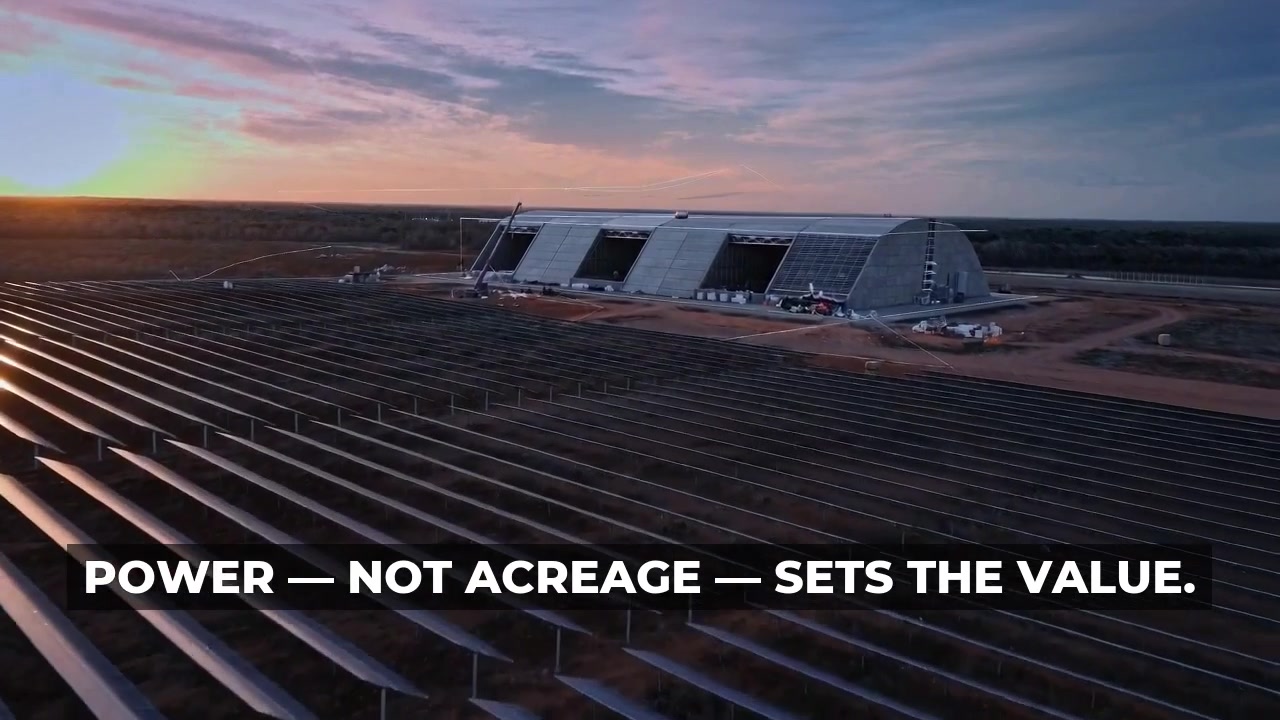
I once called two of the Southeast’s top brokers about a property I was appraising: a 350,000-square-foot greenhouse development, a partially built concrete tilt-up with a solar farm attached. I came ready to talk about the building. Neither broker asked a single question about it — not the size, not the condition, not the cost to complete. They wanted the solar farm: How many megawatts? Where does it interconnect? Is there an offtake agreement? When I pressed one of them on what the building was worth, he paused and said, “Honestly? The building is in the way.”
The power was worth more than the property. I had gone in to appraise a building with a power plant attached; the market saw a power plant with a building problem.
That inversion is now playing out at national scale in data-center land, and it is generating exactly the kind of work that lands on the desks of attorneys, CPAs, and lenders: entitlement fights that kill billion-dollar projects on procedure, service agreements that may not survive a closing, decade-long payment obligations hiding in utility tariffs, and a foreclosure question no court has answered yet. This edition walks through the life of a data-center site — approval, transfer, operations, distress — and flags what to ask at each stage before your client signs.
Key takeaways for attorneys, CPAs, and lenders
- Projects now die on procedure. The Digital Gateway — roughly 2,000 acres in Prince William County, Virginia, projected by county finance officials at nearly $25 billion in potential investment — was voided over defective public notice and abandoned in July 2026 after the developer withdrew its final appeal. Entitlement risk is litigation risk.
- The power rights may not follow the deed. Utility capacity rights generally arise from contracts and tariffs, not recorded real-property interests, and the new large-load tariffs are largely silent on assignment. What conveys at closing is a question few purchase agreements answer.
- The obligations appear on no title report. Minimum-billing commitments, exit fees, and collateral requirements can exceed the land’s value many times over, and a foreclosing lender may not be able to reach the power agreement it thought it was underwriting.
Beyond the Core Four examines specialized properties outside the traditional industrial, retail, multifamily, and office categories — quarries, marinas, agricultural facilities, processing plants, and other assets where the real estate is only part of the story. Data centers raise more issues than one edition can hold: this one takes on power. Coming editions take on water, and after that the fights over noise, light, jobs, and tax dollars. Consider this the first installment of a series worth following to the end.
The asset is a place in line
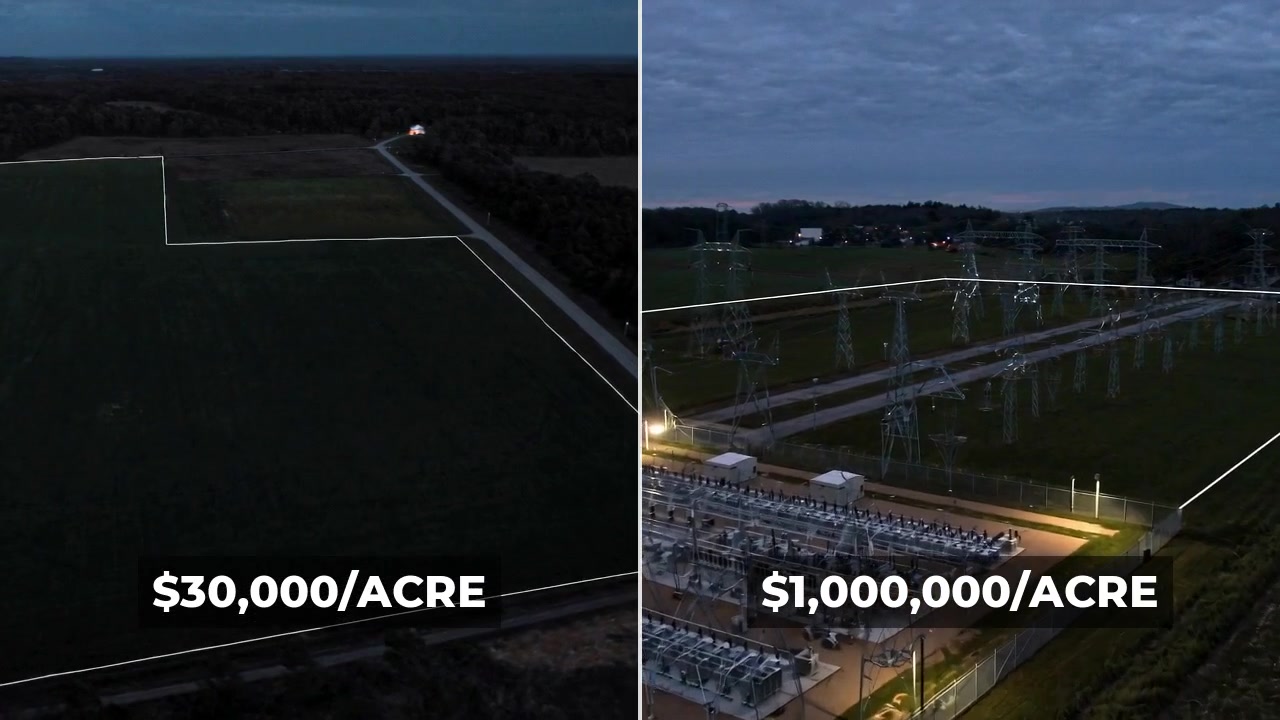
Start with what the market is pricing. IBISWorld estimates hyperscale data-center revenue at $271.6 billion in 2026, up 26.5% in a single year, and identifies grid access — not customer demand — as the primary constraint on new development. Brokers call the resulting asset class “powered land”: rural tracts that traded at $10,000–$30,000 per acre now bring $200,000 to $1 million per acre when a credible power path exists, with Northern Virginia sites reported by CBRE above $8 million per acre and Amazon’s $700 million purchase of approximately 189 acres of entitled data-center land in Prince William County — a price paid for zoning, infrastructure position, and development rights, not raw dirt — as the benchmark. Two adjoining tracts outside Atlanta — same zoning, same soils, same transmission line at the fence — can differ in value tenfold because one holds an executed electric service agreement and the other holds a courteous letter saying capacity “may be available.” The first is data-center land. The second is a farm with a rumor.
The line itself is brutal. Dominion has logged roughly 70,000 MW of data-center requests in Virginia against an all-time system peak near 24,700 MW; ERCOT’s large-load queue hit 233,000 MW; of Georgia Power’s 50,000 MW pipeline, state commission staff testified that only about 1,900 MW was contract-backed. When AEP Ohio attached real money to the question, 30,000 MW of requests collapsed to roughly 5,600 MW of signed contracts. A queue position is not an entitlement. It is a place in a line that mostly ends in exits — which is why the documents evidencing your client’s place in that line deserve the same scrutiny as the deed.
Approval: where counsel earns the fee first
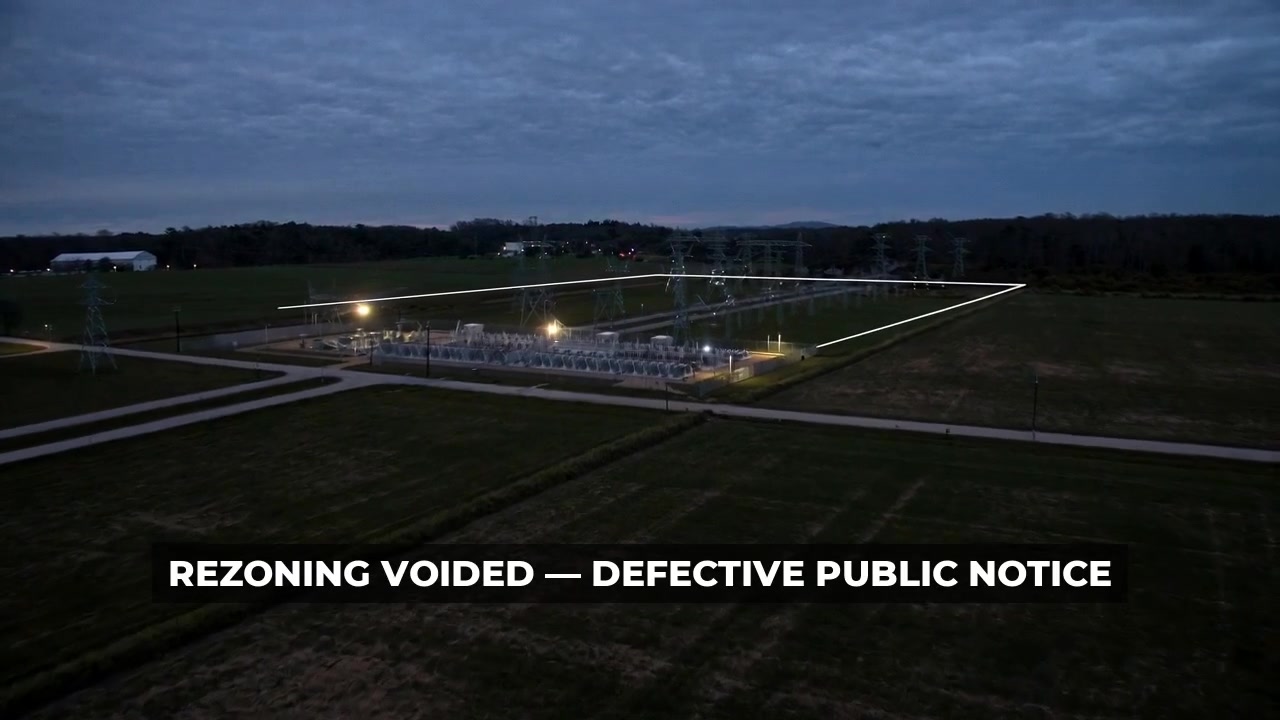
The Digital Gateway is the cautionary tale. Prince William County approved the roughly 2,000-acre rezoning in December 2023 after a 27-hour hearing; a circuit court voided it in August 2025 because the public notice was defective under Virginia Code § 15.2-2204 and the county’s own zoning ordinance; the Court of Appeals affirmed on March 31, 2026; and on July 2, 2026, QTS withdrew its remaining appeal, ending a campus county finance officials had projected at approximately $24.7 billion in potential capital investment. Not on the merits. On notice.

The pattern is repeating. Community groups sued over a data-center rezoning in Stokes County, North Carolina; residents challenged the approval process for a Joliet, Illinois project in May 2026; and Prince William’s board, chastened, rejected the next big campus proposal within a week of Digital Gateway’s death. So ask early: Was every notice, hearing, and condition bulletproof, or is your client buying two years of appellate risk? Who bears the carry — the land loan, the option payments, the utility deposits — while an appeal runs? Does the purchase agreement even address a voided rezoning? A suggestion for deal counsel: treat the entitlement record the way lenders treat a survey. Pull the notices, the transcripts, the conditions; assume an opponent with standing and a lawyer will read them too, because in Virginia one did, and a campus projected at nearly $25 billion was terminated before a single building rose — the land, for now, still farmland.
Transfer: does the power follow the deed?
Here is the question I find most professionals have not asked: when the land sells, does the power go with it?
The honest answer, after reviewing the new tariffs and rules: they frequently do not answer the transfer question clearly. The most-negotiated data-center tariff in the country — AEP Ohio’s, approved July 2025 — contains no assignment clause. Georgia’s PSC rules for loads of 100 MW and larger make each contract a bespoke instrument, negotiated with Georgia Power and filed with the Commission before signing. Utility capacity and service rights generally arise from contracts and tariffs rather than recorded real-property interests — closer to the opposite of an appurtenance that runs with the land — and their assignment may require utility consent or a replacement agreement. As one national law firm put it in May 2026, when capacity, incentives, or rate classes are state-conferred and tied to operational conditions, “transferability to a purchaser becomes uncertain.” In practice, transfer runs through utility consent — and, for Georgia loads at or above the applicable threshold, may require Commission review or a new filing, depending on the resulting contract. The deed conveys the dirt; the megawatts live in paperwork the county recorder has never seen.
Suggestions follow directly. Put the utility position in the purchase agreement: representations on queue status, study results, deposits, and defaults; a condition precedent of utility consent to assignment; escrowed value for capacity that fails to transfer. CPAs should look just as hard at the allocation. Under many utility arrangements, customer-funded interconnection facilities are treated as contributions in aid of construction: the customer funds facilities the utility may own, and the required payment can include a tax gross-up — the governing tariff and construction agreement determine the result. Your client can pay for the substation and still not own it, which changes the purchase-price allocation, the insurable interest, and what a lender’s collateral package really contains.
Operations: obligations that outlast the project — and neighbors with lawyers
The same instruments that create the power right create something that looks less like a utility bill and more like a bond indenture. Roughly 77 large-load tariffs were pending or in place across 36 states by March 2026, and the terms rhyme: AEP Ohio’s 12-year contracts with minimum charges on 85% of contracted capacity and an exit fee near three years of minimums; Dominion’s new 14-year rate class effective 2027; DTE’s approved Michigan contracts running a minimum of 19 years at 80% minimum billing with a termination payment of up to ten years of minimum bills; Georgia Power contracts up to 15 years with readiness-cost recovery on early exit. Run the math on a gigawatt-class commitment and the termination payment becomes a contingent claim that — depending on the tariff, the contracted demand, and the applicable minimum charge — can exceed the underlying land value many times over, sitting with a thinly capitalized special-purpose vehicle, not on record title. CPAs: has anyone modeled that commitment, disclosed it, or reserved for it? If your client’s audit committee saw it stated as debt, would the deal still pencil?
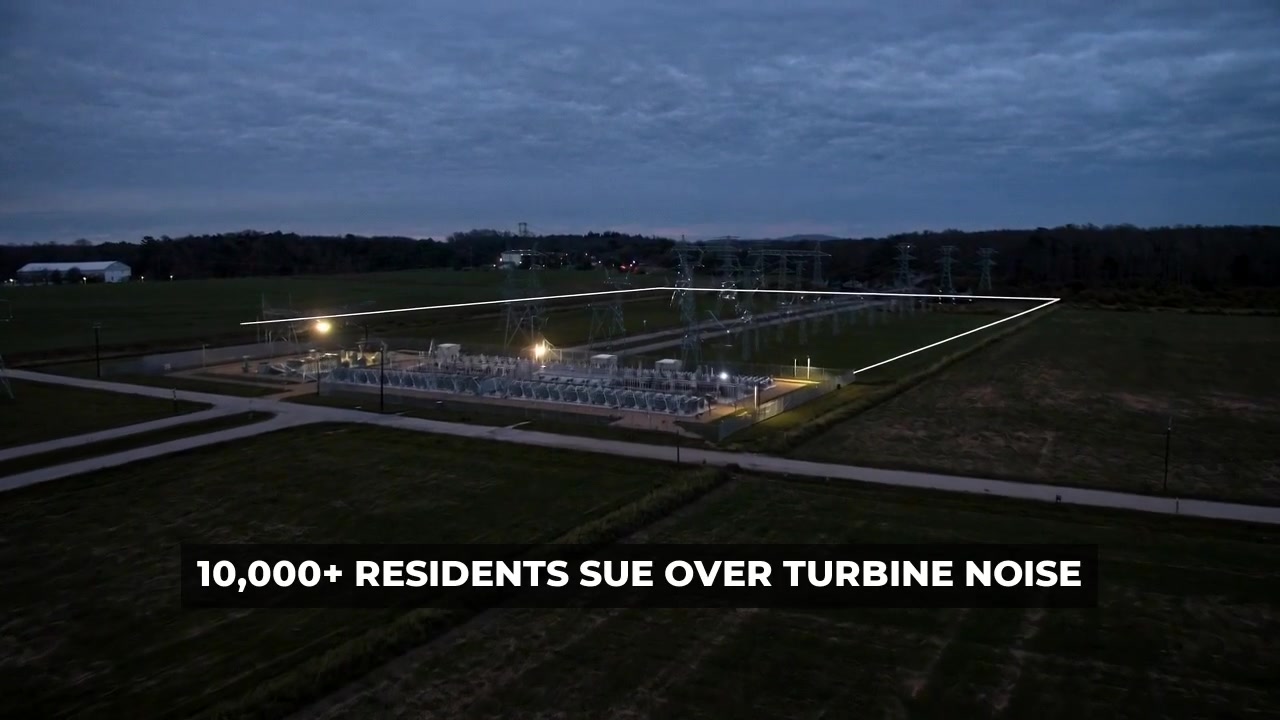
Meanwhile the operational phase has developed a litigation docket of its own. A July 2026 survey by a national firm catalogs the wave: a class action by more than 10,000 Mississippi residents over the “continuous engine roaring” of gas turbines powering an AI facility; noise and vibration class actions filed in New Jersey, Michigan, and New York, plus a Texas case that has already survived a motion to dismiss; a Clean Air Act citizen suit over unpermitted turbines in which the Justice Department intervened, citing national priorities — and a $20.5 million settlement in Oregon over groundwater contamination. For counsel structuring these deals, nuisance exposure is now a diligence item: demand the sound study, cap the generator-testing windows in the conditions of approval, and price the indemnities. For the accountants: contingencies of this size belong in the conversation before the client is a defendant.
Distress: the foreclosure no court has graded
Now the scenario your lender clients should war-game. The borrower is an SPV; the utility contract names the SPV as customer of record; the loan is secured by the real estate. The project stalls, and the lender forecloses on land whose value was underwritten on the strength of a power position the mortgage may not reach. Can the lender compel assignment? Does the exit fee — those ten years of minimum bills — stand between any buyer and the capacity? A February 2026 litigation survey reported that it had identified no judicial decision addressing enforcement of these newly structured exit obligations. The first insolvency of a committed large-load customer will write that law, and someone’s client will pay the tuition.
The one precedent we have is sobering: in the Compute North §363 sales, energized sites sold on per-megawatt metrics while the development site without a completed power position drew no bids. The market has priced the same lesson from the other direction — IBISWorld reports record deal volumes and premium valuations for platforms with secured power, because scarcity has made acquisitions faster than construction. Suggestions for the credit file: a tri-party consent with the utility executed at origination, not workout; covenants tying loan advances to power milestones rather than construction milestones; and an appraisal that separately states the value with and without the utility position, so the committee knows what evaporates on default.
When the customer becomes the utility
The strangest development is the one my greenhouse brokers saw coming: the customers are turning into power companies. FERC data show electric sales by technology companies exceeded $150 million in the second quarter of 2025, more than triple early 2021. Corporate buyers locked up over 20 gigawatts of clean-energy capacity in 2024; Amazon and Google are backing small modular reactors; Microsoft is buying power from the restarted Three Mile Island plant; nuclear plants ran at a 92.3% capacity factor in 2024, against 59.9% for natural-gas combined-cycle plants. Where nuclear is too slow, developers pair solar with batteries — which is how a solar farm ends up outshining a 350,000-square-foot building. For the professionals, on-site generation is one more bundle of rights to inventory: its own interconnection agreement, its own offtake contract, its own tax credits and depreciation, and a real-versus-personal-property classification that decides what secures the mortgage and what the assessor reaches.
The bargain with the community
The last set of issues is political, and it is coming to a county commission near your clients. The promise is tax base; the complaint is that the jobs never arrive. New Brookings research finds counties landing their first large data center do see private employment grow 4%–5% over five or six years — but the gains concentrate in hyperscale counties. In the Brookings researchers’ sample, estimated incentives in colocation counties equaled roughly 62% of investment — and those counties showed the weakest employment effects. The fiscal ledger is contested in both directions: Georgia’s state audit estimated the exemption — reported at $474 million for FY2025 — returned roughly four cents in state revenue for every dollar forgone, while a Virginia legislative study defended its exemption as producing $6.10 of labor income per dollar. Legislatures are splitting the difference with strings attached — ratepayer-protection bills like Georgia’s SB 34, California’s SB 57 study mandate, Virginia’s new per-kilowatt-hour tax, and abatements with clawbacks that snap back if construction halts. Ask whose side of that ledger your client is on, and whether the incentive package survives a sale, a foreclosure, or the next session. Increasingly, the honest answer is “read the clawback.”
Coming in this series
Power is only the first utility in the fight. On deck for future editions of Beyond the Core Four:
- Water (next edition): cooling a large campus can draw millions of gallons a day — the consumption of a small city — and the moratoria, well-interference claims, and discharge disputes are already in the record.
- Noise and light: the nuisance class actions are multiplying, and the ordinances (decibel caps at the property line, dark-sky requirements, generator-testing windows) are quietly redrawing the buildable envelope.
- Jobs and the fiscal bargain: what a community actually receives, what it gives up, and how clawback provisions are being drafted when the promises miss.
If your practice touches land use, tax, lending, or the clients who own the dirt, this series is being written for you.

Ten questions before your client signs
- What instrument evidences the power — an inquiry, a study agreement, a will-serve letter, a capacity reservation, or an executed electric service agreement — and what does it obligate the utility to deliver, by when?
- Who is the utility’s customer of record, and does any document permit assignment to a purchaser or a foreclosing lender, on what consent conditions?
- Is the entitlement record — notices, hearings, conditions — clean enough to survive the appeal someone is already drafting?
- What minimum-billing percentage, contract term, exit fee, and collateral ride with the power, and has anyone stated them as a liability?
- If the site sells or fails before energization, what happens to the queue position, the deposits, and the study results?
- Who owns the substation once built, and how does the contribution-in-aid-of-construction gross-up land in the tax workpapers?
- Does on-site generation — solar, batteries, a small modular reactor — carry its own interconnection and offtake rights, and do they convey with the land, the equipment, or neither?
- What do the sound study, the generator-testing limits, and the local ordinances leave of the site plan — and of the nuisance defense?
- Do the tax incentives survive a change of ownership or operator, and what triggers the clawback?
- Does the pro forma survive a tariff change, a rate case, or the repeal bill already filed in that legislature?
The question that decides value
Whether a parcel can physically accommodate a data center is now the least interesting question about it. What decides value is whether the required infrastructure and the rights to it can be delivered with sufficient certainty, at an identifiable cost, within a financeable timeframe — and whether those benefits, and the obligations bolted to them, follow the property or stay behind with the seller.
My greenhouse brokers understood this before I finished my first question. Some of the most valuable “real estate” in America right now is not, strictly speaking, real estate at all — and some of the largest liabilities attached to land appear on no title report. This is the work our team does: solving complex real estate and personal property problems — untangling what a client owns across land, improvements, equipment, contracts, and regulatory positions, and turning that inventory into numbers counsel, CPAs, and lenders can defend. Data centers are simply the newest place where the property and the rights have come apart. Next time: the water.
A question for your practice: When a client calls about “data-center land,” does your diligence start with the acreage — or with the paperwork that determines whether power, incentives, and obligations will follow the deed?
Sources and further reading
Industry research (IBISWorld): Hyperscale Data Center Services in the US (OD6584, Mar. 2026); Colocation Facilities in the US (OD5899, Oct. 2025); Data Center Colocation Services in the US (OD6203, Sept. 2025); Data Processing & Hosting Services in the US (51821, July 2026); “The Rise of Data Centers: The Impact on Consumers and the Energy Sector,” IBISWorld Analyst Insights (May 7, 2026).
Litigation and land use: WilmerHale, “Data Centers in Court: The Emerging Wave of Nuisance, Environmental, and Land-Use Litigation” (July 13, 2026); WTOP / InsideNoVa / Virginia Lawyers Weekly coverage of the Digital Gateway rulings and QTS’s July 2, 2026 withdrawal; Williams Mullen, “Digital Gateway in Jeopardy: How Notice Defects Could Invalidate Rezoning Approvals”; Southern Environmental Law Center, Stokes County, NC rezoning suit; Shaw Local, Joliet, IL data-center suit (May 2026); Quinn Emanuel, AI data-center financing and litigation risks (Feb. 2026); Hashrate Index, Compute North §363 sale analysis.
Government and regulatory: Georgia PSC, large-load rules advisory (Jan. 23, 2025); Michigan PSC, DTE/data-center contract approvals, Case U-21990 (Dec. 18, 2025); Georgia Dept. of Audits, Data Center Tax Exemption Evaluation (Dec. 2025); FERC, order on PJM co-located load, Docket EL25-49 (Dec. 18, 2025); Virginia JLARC, Data Centers in Virginia (2024); California SB 57 (2025); Georgia SB 34 (2026); Virginia data-center electricity tax (eff. July 2026).
Utility, market, and economic analysis: AEP Ohio Schedule DCT and PUCO approval coverage (KJK, Nov. 2025); Dominion GS-5 rate class, SCC biennial review; ERCOT large-load queue reporting; NV Energy Rule 9 (contributions in aid of construction); Nixon Peabody, data-center site-selection alert (May 7, 2026); CBRE, North America Data Center Trends H2 2025; Utility Dive, 50-state large-load tariff survey (Mar. 31, 2026); Brookings, “New evidence on data center employment effects” (2026); Cardinal News, Virginia incentive-study coverage (June 19, 2026); Meta investor press release, Hyperion joint venture (Oct. 2025).
The opening account is drawn from an actual assignment, with identifying details omitted; the two-parcel example is a hypothetical presented for illustration. Case details, figures, and identifiers discussed from public sources are cited to those sources. The discussion is grounded in real-world appraisal experience and is presented for educational purposes only. It is not valuation, legal, engineering, utility-regulatory, or investment advice for any specific property, transaction, or dispute. Utility tariffs, regulatory requirements, incentive programs, and pending litigation vary materially by jurisdiction and change frequently; readers should confirm current requirements with the relevant utility, commission, and counsel.
If a client’s holdings raise these questions — land near a substation, a site with a pending interconnection request, a facility where the real estate, the equipment, and the contracts intertwine — that intersection of complex real estate and personal property is where our team works. We regularly speak to law firms and legal teams (including CLE-style briefings), CPA firms and societies (including CPE-style sessions), lenders, family offices, owner-users, and industry groups on complex property and specialized asset issues. If your firm would like a private session on these topics, feel free to reach out.
Daniel Boring, CRE®, MAI, ARA, ASA | Senior Vice President – Valuation Advisory Services | Kidder Mathews