Public Works, Private Capital · Part 1 of 3
One sewer system can carry three defensible values on the same day. An accounting manual, a state statute and a utility commission decide which of them an investor may earn a return on.
The same pipe, three prices. A municipal water and wastewater system valuation can produce three supportable numbers for one set of assets: what the system cost when it first went into service, less depreciation; what it would cost to build again today, less depreciation; and what a buyer will pay. In Pennsylvania’s public record, the last of those has run about twice the first.
That spread is where the investment, legal and tax questions sit. It is also why a city council, a utility, a lender and a consumer advocate can look at the same pump station and each see a different asset.
Key takeaways for investors, lenders and their advisors
- Rate base, not replacement cost, is what an investor-owned utility earns on. Under the accounting system published by the National Association of Regulatory Utility Commissioners (NARUC), acquired plant is recorded at the seller’s original cost, and any premium waits in a separate account until a commission decides who pays for it.
- State law now decides how much of the price reaches rate base. More than a dozen states have acquisition-valuation statutes. They do not agree with each other, and several are being rewritten.
- Price and earning power are different numbers. Regulated water assets trade well above net plant, yet a buyer earns its authorized return only on the portion a commission admits.
Why investors buy municipal water and wastewater systems

A water or sewer system sells a service with no substitute to customers who cannot switch providers, at prices a public body sets. That combination is what investors pay for, and the public record shows why.
Demand holds. In 2020, the first pandemic year, Fitch Ratings reported median operating revenue growth of 3.8% for the retail water and sewer systems it rates, up from 2.5% in 2019.
Defaults are rare. Moody’s counted eight defaults among rated municipal utilities from 1970 through 2022, two of them sewer systems. The sector’s ten-year cumulative default rate was 0.08%. For investment-grade corporate borrowers worldwide it was 2.23%.
Rates have outrun inflation. The federal consumer price index for water, sewer and trash collection services rose 48% from 2015 to 2025, against 36% for consumer prices overall. To an owner that is pricing power. To a commission or a city council it is an affordability problem.
The growth is scheduled. A regulated utility grows by adding plant to rate base, and the plant this sector needs is already itemized in federal surveys, permits and consent decrees. Ownership is fragmented as well. By American Water’s count, investor-owned companies hold about 16% of the country’s 50,000-plus water systems and about 2% of its 16,000-plus wastewater systems.
The income record is long. American States Water has raised its dividend for 71 consecutive years. California Water Service Group announced its 59th annual increase in January 2026, H2O America has lifted its payout in each of the past 58 years, and Middlesex Water stands at 53.
The market pays for it. A January 2026 utility outlook from Gabelli Funds put listed water utilities at 21.8 times estimated 2025 earnings. Electric utilities stood at 18.2 times and gas utilities at 17.7.
Institutions hold less than they target. Private infrastructure funds returned between 9% and 11% a year over the one, three and five years ended June 2025, according to Preqin. Institutions surveyed in 2025 by Hodes Weill & Associates and Cornell University targeted 5.9% of assets for infrastructure on average and held about one percentage point less.
The case has limits. S&P Global Ratings moved to a negative view of the public water and sewer sector in mid-2024, and its downgrades outnumbered upgrades 1.7 to 1 through the first three quarters of that year. Gabelli attributes two years of weak water utility share performance to higher interest rates. Infrastructure fundraising fell to $43.4 billion in the first half of 2026, which one data provider called a record low, after a record 2025.
One limit matters more than the others. Every attribute above belongs to the system. How much of it an owner is allowed to earn on is a separate question, and it is the subject of this edition.
Who is investing in municipal water and wastewater systems
Five kinds of capital are in this market, and each buys a different claim on the same pipes.
Listed water utilities buy systems outright and earn on rate base. They include American Water Works, Essential Utilities, California Water Service Group, American States Water, H2O America, Middlesex Water, Artesian Resources, York Water and Global Water Resources. Large fund managers stand behind them: two Vanguard entities together reported about 13% of American Water’s shares as of March 31, 2026.
Private infrastructure funds, pension managers and insurers own utilities and concessions directly.
- Nexus Water Group, which served more than 1.3 million people when it was formed in 2024, traces through a 2022 Kentucky regulatory filing to British Columbia Investment Management Corporation on one side and, on the other, to an infrastructure fund and a vehicle owned by the reinsurer Munich Re.
- Central States Water Resources, which reports more than 500,000 customers in 11 states, is a portfolio company of the Sciens Water Opportunities Fund.
- CVC DIF bought 18 Arizona water and wastewater utilities in November
- The Ullico Infrastructure Fund’s portfolio includes the company that holds a 30-year concession for the water and wastewater systems of Rialto, California, and the 142-mile Vista Ridge pipeline that supplies San Antonio.
- Aberdeen has owned the Carlsbad, California desalination plant since
- Ridgewood Infrastructure closed its second water and strategic infrastructure fund at $1.2 billion in January 2025.
Public buyers compete for the same assets. Aquarion Water Authority, a political subdivision of the State of Connecticut, closed its $2.4 billion purchase of Aquarion Water on June 30, 2026.
Government lenders supply below-market debt. The U.S. Environmental Protection Agency (EPA) reports that the Clean Water State Revolving Funds (SRFs) run by the states have provided $194 billion to communities through 2025, built on $62.4 billion of federal money. EPA’s Water Infrastructure Finance and Innovation Act (WIFIA) program has closed 157 loans totaling $24 billion.
Municipal bondholders are the lenders a city already has. Federal Reserve data show $4.4 trillion of municipal securities outstanding at the end of 2025, issued for every public purpose, water among them. Of the holdings the Federal Reserve assigns, households held about 48% directly, mutual funds and other funds 29%, insurers 9% and banks 8%. Congress left the tax exemption for that debt intact in the tax law signed on July 4, 2025.
Part 3 turns to public buildings, where the roster changes to partnership developers. Two examples: Plenary Americas, acquired in 2020 by the Quebec pension manager Caisse de dépôt et placement du Québec (CDPQ), and Fengate, whose Oregon courthouse partnership includes a Canadian union pension fund.
These investors price the same city differently because each holds a different claim. Equity earns on rate base, a concession earns on a contract, and lenders are repaid from rates.
A composite, not a client
The following is a composite assembled from public records in several states. It describes no single assignment.
An older city owns its sewer system. The mains went in over the course of a century. The treatment plant was expanded with federal grant money decades ago and with SRF loans since. The city’s audited financial statements carry the whole system at a modest figure: much of it was depreciated long ago, developers contributed part of it, and years of pump, motor and control replacements were charged to maintenance and never capitalized. A regulator has ordered overflow work the ratepayers cannot comfortably fund. An investor-owned utility calls with an offer well above book.
Three values are now in the room. The city’s finance director has one from the balance sheet. The engineer has another from a replacement estimate. The buyer has a third, and it is the only one backed by a check.
The same composite city runs through all three parts of this series. Part 1 asks which number governs and what an investor is buying. Part 2 follows the obligations that travel with the pipes and never reach the appraisal: bonds, grants, consent decrees, contamination and permits. Part 3 widens the lens to the rest of what a city owns, including public buildings, and to the concessions, partnerships and takings through which public assets change hands.
Why municipal water and wastewater systems are on the market
The United States has roughly 50,000 community water systems, and one large investor-owned utility reports that about 81% of them serve fewer than 3,300 customers. EPA counts 17,544 publicly owned treatment works serving 270.4 million people.
The bill for keeping them running is large and well documented:
- Wastewater and stormwater: EPA’s 2022 Clean Watersheds Needs Survey reports $630.1 billion of need over 20 years, of which $151.1 billion is for repairing and extending conveyance, the pipes themselves.
- Drinking water: EPA’s seventh needs assessment adds $625 billion over 20 years.
- Condition: the American Society of Civil Engineers’ 2025 report card grades wastewater D+, stormwater D and drinking water C-.
Federal help is receding. The 2021 Infrastructure Investment and Jobs Act sent more than $50 billion to EPA for water over federal fiscal years 2022 through 2026, and that stream ended on September 30. In the regular fiscal 2026 appropriation, Congress directed 54% of the Clean Water SRF line and 64% of the Drinking Water SRF line to earmarked projects. The President’s fiscal 2027 budget asks for a cut of about 90% to both funds.
Ratepayers are making up the difference. The National Association of Clean Water Agencies put the average annual single-family sewer charge at $612 in its 2024 index, nearly double the 2007 figure, and projected increases of roughly 5% to 6% a year through 2029. EPA estimated in late 2024 that between 12.1 million and 19.2 million households already lack affordable water service.
IBISWorld’s 2026 industry reports describe the same pattern from the operator’s side: no sewage treatment operator holds more than 5% of industry revenue, and municipalities short of capital are increasingly turning to private partners. Consolidation is following. American Water Works and Essential Utilities announced an all-stock merger in October 2025 that would combine about $29.3 billion of water and wastewater rate base and 4.7 million connections in 17 states. As of early October 2026 it had not closed.
What NARUC’s accounting rules require in a utility valuation
NARUC is an association of state regulators, not a regulator. Its Uniform System of Accounts binds a utility only where a state commission has adopted it. Many have, in one edition or another, and the 1996 edition is still the one written into a number of state rules. NARUC’s board adopted a revised edition on November 13, 2024, and states are taking it up one at a time.
Three rules in that system do most of the work in a transaction.
1. Original cost follows the property, not the owner. The definition is one sentence: original cost “means the cost of such property to the person first devoting it to public service.” A main laid in 1962 carries its 1962 cost through every later owner. A sale does not reset it.
2. A purchase premium is parked, not capitalized. When a utility buys a system, the plant goes on its books at the seller’s original cost less accumulated depreciation. The difference between that figure and the price paid goes to Account 114, Utility Plant Acquisition Adjustments, and stays there until the commission says otherwise. NARUC’s own rate case manual is candid about what happens next: “It is at the discretion of each jurisdiction as to whether or not the acquisition adjustment is included in rate base.” The accounts even provide two exits. Amortization charged above the line is paid by customers. Amortization charged below the line is paid by shareholders.
3. Contributed plant earns nothing. The same manual states that contributions in aid of construction (CIAC) “reduce the rate base.” Mains installed by a developer and plant paid for with grants were not funded by investors, so investors earn no return on them.
The arithmetic that follows is short. NARUC’s manual writes the revenue requirement as R = E + (V × r): operating expenses, including depreciation and taxes, plus the value of rate base multiplied by the allowed rate of return. Everything an investor-owned utility earns comes through V.
Depreciation in this system is statistical. NARUC’s Public Utility Depreciation Practices (1996) remains the standard manual, and its 2021 primer for regulators notes that the most widely used survivor curves are the “Iowa” curves, developed at Iowa State in the 1930s. Applying them properly takes retirement records by year of installation. In my experience, municipal systems seldom have them, which means the life of a pump or a main is argued from other utilities’ data and from the condition of the asset in the ground.
What an investor is buying
Earnings follow rate base. American Water’s 2026 investor materials target rate base growth of about 8% to 9% a year alongside earnings growth of 7% to 9%. The return on equity (ROE) its state commissions currently authorize ranges from 9.45% to 10.20%, on equity ratios of roughly 44% to 57%, by the company’s own tabulation. In July 2026 the Pennsylvania Public Utility Commission set the ROE for the company’s Pennsylvania subsidiary at 9.55% on a 54.23% equity ratio, while granting less than half the revenue increase requested.
A premium outside rate base is dead money. A buyer that pays twice depreciated original cost, and is held to original cost in rates, earns its authorized return on half its investment. That one fact explains the legislative campaign of the past decade.
The return is authorized, not promised. An American Water white paper on the rate process says it directly: “A company is not ‘guaranteed’ any return.” NARUC adopted a resolution in 2013 on the gap between authorized and actual returns in the water sector, which is a fair indication that the gap is real.
Growth is bought as well as built. American Water’s capital plan runs to $46 billion to $48 billion over ten years, and its investor materials put $4 billion to $5 billion of that toward acquisitions. In 2025 it closed 18 small acquisitions for $83 million.
The market pays more than book. Pennsylvania’s commission now publishes a reference ratio for exactly this purpose: enterprise value divided by net plant for a group of publicly traded water utilities, averaged over a rolling ten years. For the year ended December 31, 2025 it stood at 1.59. When Eversource sold Aquarion Water in 2026, it described the price as 1.7 times rate base. The buyer was a public authority, so the bidding runs in both directions.
Announced prices show how wide the range is once the buyer, the statute and the system change.
| Transaction | Announced price | Size | Price per connection |
|---|---|---|---|
| American Water, 18 small systems closed in 2025 | $83 million | about 20,900 connections | about $4,000 |
| Nexus Water Group systems in eight states, closed June 2026 | about $315 million | about 47,000 connections | about $6,700 |
| Aquarion Water, sold to a public authority, closed mid-2026 | about $2.4 billion | nearly 250,000 customers | about $9,600 |
| Butler Area Sewer Authority, Pennsylvania, closed October 2024 | $230 million | more than 15,000 connections | about $15,000 |
The last column is my arithmetic from announced figures. It is not a published statistic and it is not a valuation method. Customers and connections are not identical counts, and a per-connection price says nothing about condition, admitted rate base or the capital orders waiting behind the sale. The spread is the point.
What to test in a seller’s numbers. Five questions sort a municipal system’s book value into what an investor can use:
- How much of the plant was contributed or grant-funded?
- How much of the original cost is recorded, and how much is an estimate trended back from today’s prices?
- Was equipment capitalized and retired on the books, or expensed as it was replaced?
- What depreciation lives were used, and on what evidence?
- What capital work has a regulator already ordered?
Three values in a municipal water and wastewater system valuation, and how the states choose
Depreciated original cost is the NARUC measure: first cost, less book depreciation. For a municipal seller it tends to be low. Governmental accounting carries assets at historical cost, grants and contributions come out under the utility convention, and, in my experience, a good deal of equipment was expensed along the way.
Reproduction cost new less depreciation (RCNLD) prices an identical system at today’s costs and deducts for age and condition. It ignores who paid for the plant originally.
Fair market value is the appraiser’s standard: cost, market and income approaches, reconciled.
More than a dozen states have enacted statutes that let something above depreciated original cost into rate base when a regulated utility buys a municipal system. Their mechanics differ more than the shared label suggests.
| State | Authority | How the price reaches rate base |
|---|---|---|
| Pennsylvania | 66 Pa.C.S. § 1329 (2016) | Two appraisals, one for each side, using cost, market and income approaches. Rate base is the lesser of the price or the average. |
| Illinois, North Carolina, Ohio, Texas | 220 ILCS 5/9-210.5; G.S. 62-133.1A; R.C. 4909.052; Water Code § 13.305 | Three appraisals. Rate base is the lesser of the price or the appraised value. The Illinois statute is scheduled for repeal on June 1, 2028. |
| Missouri | RSMo 393.320 (2010; amended 2013, 2025) | At least two appraisers, one named by each party. Lesser of price or appraised value. |
| Iowa | Iowa Code § 476.84 (2018) | Fair market value is the greater of the two-appraisal average, the depreciated value of the assets, or the amount needed to retire the system’s debt. Rate base is the lesser of the price or that figure. |
| New Jersey | P.L. 2015, c. 18 | The board accepts a reasonable negotiated price as rate base. The original source of funding is not relevant to value. |
| West Virginia | W. Va. Code § 24-2-4g (2020) | A negotiated price supported by depreciated original cost, RCNLD or other industry-standard utility methods, “excluding the use of fair market appraisal valuation methods,” and determined regardless of the original sources of funding. |
| California | Pub. Util. Code §§ 2718–2720 (1997) | Fair market value is the rate base standard. A July 2026 commission decision places the burden on the buyer to justify any premium. |
Pennsylvania has the deepest record. In January 2024 testimony, the state’s Consumer Advocate tabulated 21 closed transactions under Section 1329: combined ratemaking rate base of about $1.097 billion against depreciated original cost of about $538 million, with an annual revenue requirement effect of roughly $85 million. In the largest transaction on that list, a city wastewater system entered rate base at about $231.5 million against depreciated original cost of about $97 million.
The response has come from three directions:
- The regulator. In 2024 the commission required public hearings before a purchase agreement is signed, set default weights of one-third each for the cost, market and income approaches, and began publishing the reference ratio described above.
- The courts. On December 16, 2025, the Pennsylvania Supreme Court reversed a lower court that had blocked one of these sales. It held that the commission’s weighing of benefits deserves deference and declined to treat a rate increase as a “known harm.” The case went back on a remaining evidentiary question.
- The legislature. A bill to impose a moratorium and repeal Section 1329 cleared two House committees in spring 2026 and had not reached a floor vote when this was written.
Why it matters, by reader
For lenders and investors
- Underwrite the admitted number. Debt sized to the purchase price is serviced from earnings on rate base. Where the two differ, the statute and the commission’s order decide whether the premium ever earns.
- Statute risk carries a date. Illinois sunsets in 2028. Pennsylvania’s repeal bill is in committee. Missouri loosened its appraisal panel in 2025, and California issued new acquisition rules three months ago. A deal signed under one regime can reach the commission under another.
- Approval is political before it is regulatory. A $1.1 billion offer for a Pennsylvania county authority was withdrawn in 2022 after county commissioners opposed it. A $104 million township sewer sale was terminated in 2024, and the buyer cited the commission’s new review criteria. In November 2024, voters in one New Jersey township rejected a $143 million sewer sale by about four to one.
- Capital needs do not stop at closing. The orders that prompted the sale become the buyer’s capital plan, and the rate increases that fund it are the buyer’s next proceeding.
For real property, trust and estate attorneys
- Name the standard of value before naming the appraiser. The same system has one value in a rate case, another in a statutory sale and a third in a taking. When a city condemns an investor-owned system, courts award fair market value, and ratemaking conventions do not cap it. Maryland’s highest court restored a jury award that included contributed plant, holding that the ratemaking theory “cannot be transported from rate-making into eminent domain.” In Missoula, Montana, condemnation commissioners set value at $88.6 million in 2015; the city’s own brief put the company’s rate base near $39.7 million.
- Read the statute for who picks the appraisers and what binds them. Pennsylvania gives each side one. Texas has the commission select three from a list. Ohio’s three are chosen jointly. Several statutes name the Uniform Standards of Professional Appraisal Practice (USPAP) and require the cost, market and income approaches. West Virginia excludes fair market appraisal methods altogether.
- Process now precedes signature. Pennsylvania requires public hearings before the purchase agreement is signed. North Carolina added a public hearing and a public-interest finding for local government sales in July 2026. New Jersey allows a referendum on petition by 15% of voters.
- Easements are part of the asset. A collection system occupies other people’s land, and rights-of-way that were never recorded are a title question before they are a value question.
For accountants and certified public accountants
- Purchase price allocation. An asset acquisition is allocated under Internal Revenue Code § 1060 using the residual method, and a written allocation binds both sides. For a utility, the boundary between real property, equipment and intangibles is contested ground, and the regulatory books and the tax books will not match.
- Depreciation is slower than clients expect. Section 168(k)(9) excludes property used in a rate-regulated water or sewage disposal business from bonus depreciation. Water utility property and municipal sewers recover over 25 years, straight line. A municipal wastewater treatment plant is 15-year property.
- Contributed plant has three values at once. For contributions made after 2020, Section 118(c) again excludes CIAC from a regulated water or sewer utility’s income, but the property takes a zero basis. It is also outside rate base. In condemnation, courts have held it compensable.
- The seller’s books are a starting point. Governmental Accounting Standards Board (GASB) Statement 34 carries capital assets at historical cost. That figure is not original cost as a utility commission defines it, and it is rarely complete for equipment.
For municipal owners and operators
Know the three numbers before the offer arrives. Keep the project files, grant closeouts and bond documents, because they are often the only dated cost evidence left for older plant. Inventory the equipment separately from the pipe.
Where the machinery and equipment fit
The pipe is long-lived and mostly invisible. The equipment is neither. Florida’s commission rule, one of the few published guideline tables, assigns gravity sewers a 45-year life and pumping equipment 18 years; power generation equipment gets 20 and communication equipment 10. The pumps, drives, generators and control systems are the part of the system an owner buys again and again.
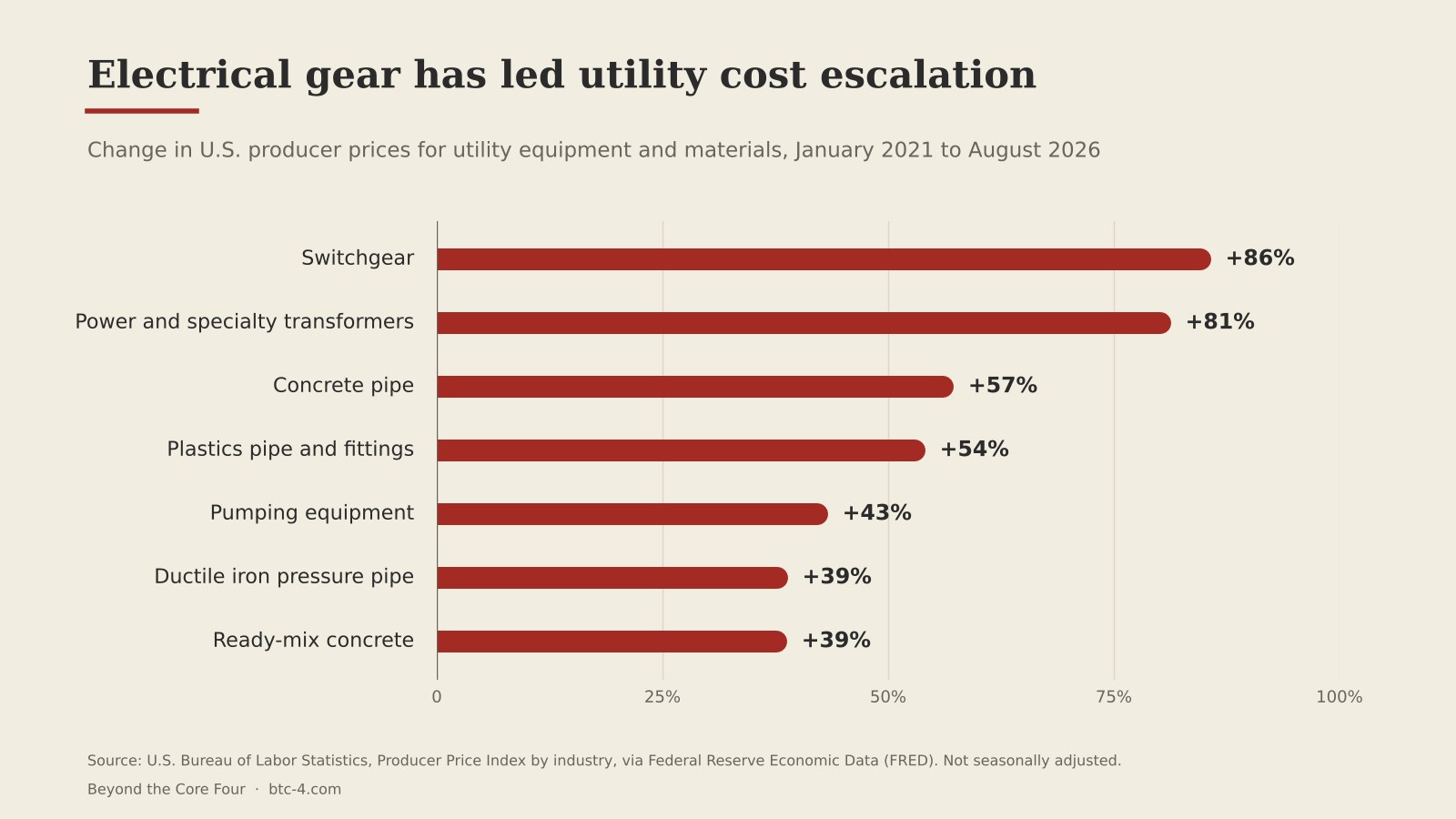
They are also where costs have moved most. From January 2021 to August 2026, the Producer Price Index for switchgear rose about 86% and for power transformers about 81%. Pumping equipment rose about 43%, against 39% for ductile iron pipe and ready-mix concrete. Switchgear alone rose about 13% in the twelve months to August 2026. A reproduction cost estimate built on indexes from the wrong month can be materially off.
Condition data needs the same care. The sewer inspection grades engineers report under the National Association of Sewer Service Companies’ pipeline assessment program are often read as a countdown to failure. The association’s own guidance says remaining useful life is not defined for any grade.
Three practical consequences follow, and they are the same ones I raise on any machinery and equipment assignment inside a larger property:
- The equipment needs its own schedule and its own depreciation analysis. An average borrowed from the pipe will not serve.
- The boundary between real property and equipment has to be agreed before anyone counts, or a pump is valued twice or not at all.
- Supervisory control and data acquisition (SCADA) software licenses, warranties and service agreements are assets only if they can be assigned.
What Part 1 leaves out, on purpose
Value is one question. What travels with the system is another, and none of it is resolved by the appraisal. Part 2 takes up:
- tax-exempt bonds that must be redeemed or defeased on a 90-day clock when a system is sold;
- federal grants and rural utility loans that carry their own disposition and payoff rules;
- consent decrees, which do not transfer with the assets unless the government agrees;
- contamination liability and sludge disposal costs;
- permits, proceeds restrictions and cybersecurity.
Frequently asked questions
What is rate base, and why does it drive municipal utility value? Rate base is the investor-funded plant on which a regulated utility may earn its authorized return. Under NARUC accounting it starts from original cost less depreciation and excludes contributed plant. A price above that figure earns a return only if a statute or commission order admits it.
What is a utility plant acquisition adjustment? It is the difference between what a utility pays for a system and the system’s original cost less depreciation. NARUC accounting holds it in a separate account, and the commission decides whether customers or shareholders bear it.
Is fair market value the standard when a city sells its water or sewer system? It depends on the state. Pennsylvania, Texas, North Carolina and others average appraisals built on the cost, market and income approaches. West Virginia excludes fair market appraisal methods by statute. A condemnation generally applies fair market value, whatever the ratemaking rules say.
Does NARUC require an appraisal? No. NARUC’s system is accounting. The appraisal requirement, and any reference to USPAP, comes from state statutes such as those in Pennsylvania, New Jersey, Missouri, North Carolina and Texas.
The broader lesson
In most of the properties this newsletter covers, the real estate is visible and the operating platform explains the value. A utility reverses that. The assets are buried, and the value is a regulatory construct: a number on a ledger that a commission has agreed customers will pay a return on. Buyers are purchasing the ledger as much as the pipe. Sellers are deciding what to do with obligations that do not appear on it.
A question for your practice: when a client asks what the system is worth, which of the three numbers does the engagement call for, and who is responsible for everything that travels with it?
A one-page checklist, Twelve Questions Before a City Sells Its Utility, accompanies this series. Message me for a copy.
If your firm would like a private presentation on these topics, feel free to reach out. I regularly present to law firms and legal teams (including continuing legal education (CLE)-style briefings), certified public accountant (CPA) firms and societies (including continuing professional education (CPE)-style sessions), family offices, lenders, owner-users and industry stakeholders on complex property and specialized asset issues.
Daniel Boring, CRE®, MAI, ARA, ASA | Senior Vice President – Valuation Advisory Services | Kidder Mathews
Beyond the Core Four focuses on specialized properties that fall outside the traditional industrial, retail, multifamily and office categories. The newsletter examines how value, risk and utility are shaped by the operational realities of assets such as quarries, marinas, agricultural facilities, processing plants, water-dependent operations and other complex property types where the real estate is only part of the story.
Case details, figures, ownership information and property identifiers have been modified or generalized to protect confidentiality. The discussion is based on real-world appraisal and advisory experience and is presented for educational purposes only. It is not intended as valuation advice, legal advice, tax advice, accounting advice, engineering advice or investment advice for any specific property, transaction or dispute, and it takes no position on any pending regulatory proceeding. Statutes, regulations and case status are described as of October 11, 2026 and change frequently.